Books & reading samples
Look inside our books
Take your time to leaf through selected double-page spreads, open the tables of contents and download reading samples as PDF. The two volumes of Geschichte von Friesdorf and the second edition of Historisches Friesdorf will be available soon; the picture calendar 2027 is available from 1 November 2026. All books are in German; the tables of contents are translated here.
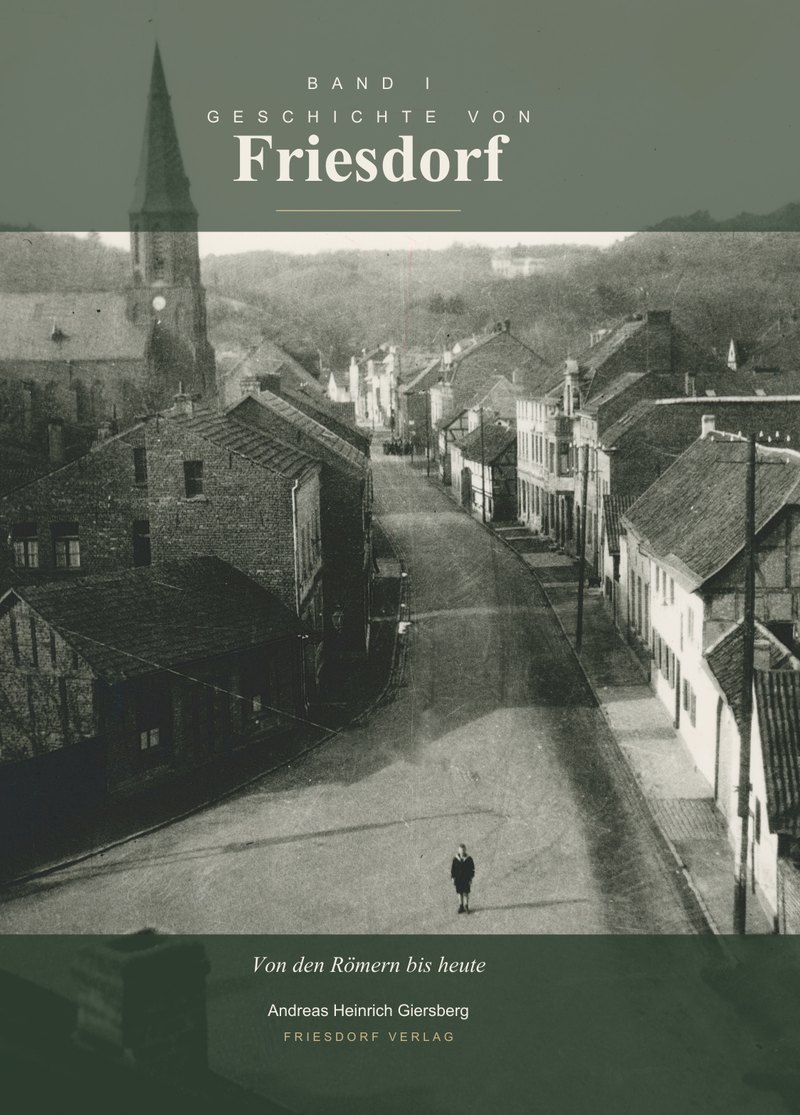
- Format
- Hardcover, 17 × 24 cm
- Pages
- 372
- Illustrations
- 66, in colour
- Notes
- some 700
- Binding
- hardback
- Availability
- available soon
Available soon · Vol. I
Geschichte von Friesdorf
Band I – Von den Römern bis heute (Vol. I – From the Romans to the Present)
Friesdorf — today a district in the south of Bonn — looks back on almost two thousand years of history.
This first volume tells it from the very beginning: from the Roman villa rustica at the Arndtruhe, through the first mentions in Carolingian times, the knights of Friesdorf and their tower house, wars, fires and reconstruction, to the incorporation into Godesberg in 1904 — and on through the Nazi era and the bombing war, the post-war years and the Bonn Republic to the present day.
It is based on charters, files and parish registers from the Landesarchiv NRW (State Archives of North Rhine-Westphalia), the Bonn City Archives and the parish archive of St. Servatius, the Bonn daily press since 1814 and the local-history archive of the Giersberg family. Some 700 notes document the information, and 70 illustrations show old Friesdorf.
Volume II, „Höfe, Kirchen, Wege“, explores the most important places of the village in depth.
Price to follow · We will announce the price and ISBN as soon as the volume is available.
Look inside
Browse with the arrows, by swiping or with the arrow keys · click to enlarge
1/8
Village coat of arms and title page · pp. 2–3
Table of contents Vol. I · 10 chapters · translated
Chapter 1Friesdorf in Roman times13
- 1.1 Friesdorf in the Roman administration of Lower Germany13
- 1.2 A village on the edge of the empire15
- 1.3 The villa rustica „An der Arndtruhe“ – five excavation campaigns over 146 years16
- 1.4 The Klufter chapel – a Roman aedicula?22
- 1.5 The votive stone for Emperor Gordian III23
- 1.6 Friesdorf in the network of finds of the region26
- 1.7 Topography: why here of all places?27
- 1.8 The end of the villa28
Chapter 2Friesdorf in the early Middle Ages (500–1000)37
- 2.1 Between Romans and Franks – the transition37
- 2.2 The Carolingian Bonngau – administrative organisation and the Cassius foundation39
- 2.3 A possible earliest mention (722/23): Friesdorf and Godesberg43
- 2.4 Place list no. 23 and the Bernardus charter (840/41): the Gumme stream44
- 2.5 The Alvard charter (819–841): the oldest Friesdorf record surviving in full text47
- 2.6 The mention of 794/95 and the date 87349
- 2.7 Viticulture, manorial lordship and early field names50
- 2.8 The Klufterhof: an open question51
- 2.9 Friesdorf at the end of the first millennium53
Chapter 3Friesdorf in the high Middle Ages (1000–1350)61
- 3.1 Introduction: sources and a turning point61
- 3.2 The imperial political framework: archbishops, counts palatine and popes62
- 3.3 The Cassius foundation in Bonn and the new power of Heisterbach62
- 3.4 The knights of Friesdorf (1139–1349)64
- 3.5 The Cruchterhof in the high Middle Ages – a chronological overview67
- 3.6 The parish church of St. Servatius in the high Middle Ages69
- 3.7 Watercourses: Klufterbach, Annaberger Bach and Mutschgrabenweg72
- 3.8 Viticulture and manorial lordships in the high Middle Ages72
Chapter 4Friesdorf in the late Middle Ages (1350–1600)81
- 4.1 Between the plague and the Cologne War81
- 4.2 Imperial context: the world in which Friesdorf lay82
- 4.3 The last mention of the name: Bela van Vriestorp, 134983
- 4.4 The Cruchterhof in the 14th and 15th centuries: Heisterbach administration83
- 4.5 The 16th century: the Wichelshof, hereditary leases and the lawsuit over the Mass foundation84
- 4.6 The noble estates of Friesdorf 1387–159185
- 4.7 Reformation and Cologne War: Friesdorf 1583–158989
- 4.8 Reconstruction after the war91
- 4.9 The scandal of Jakobe of Baden and the von Hall family of Friesdorf (1578–1601)91
Chapter 5Friesdorf between Baroque and Enlightenment (1600–1800)101
- 5.1 Reconstruction, wars and new lords101
- 5.2 Imperial context: four wars around Bonn102
- 5.3 Rebuilding the Klufterhof after 1598104
- 5.4 From the Heisterbach lease to the Birkhäuser-Peters family105
- 5.4a The noble estates of Friesdorf 1609–1794 – handovers, lawsuits and changes of ownership106
- 5.5 The search for fuel on the Pützberg: coal prospecting c. 1675, peat and lignite digging c. 1750109
- 5.6 The parish church of St. Servatius: new building 1748–1750110
- 5.7 The Klufter chapel: demolition in 1794 and the Roman votive stone111
- 5.8 Secularisation and the end of Electoral Cologne rule112
Chapter 6Friesdorf between the Prussian era and industrialisation (1800–1914)119
- 6.1 Introduction119
- 6.2 From French département to Prussian Rhine Province (1800–1822)120
- 6.3 The mayoralty of Godesberg and its seven rural communities (1815–1900)122
- 6.4 Economy and infrastructure: Friesdorf in the industrial age (1840–1900)125
- 6.5 The prelude to incorporation: Peter Mentis and Josef Peters (1886–1902)130
- 6.6 The incorporation of Friesdorf into Godesberg (1902–1904)132
- 6.7 Friesdorf's workforce and social structure 1900–1914 – a cross-section137
- 6.8 Outlook: Friesdorf after incorporation 1904–1914145
Chapter 7Friesdorf in the First World War and the Weimar Republic (1914–1933)157
- 7.1 Introduction157
- 7.2 The First World War 1914–1918158
- 7.3 „Bonn-sur-le-Rhin“ – the occupation 1918–1926162
- 7.4 The early Weimar Republic 1919–1923164
- 7.5 Stabilisation and the title „Bad“ 1924–1926166
- 7.6 New clubs 1926–1929 – Friesdorf organises itself167
- 7.7 The parish of St. Servatius in the Weimar years172
- 7.8 The road to the Nazi era 1929–1933174
- 7.9 Outlook177
Chapter 8Friesdorf in the Nazi era (1933–1945)187
- Preliminary note on the sources187
- 8.1 Friesdorf on the eve of Nazi rule189
- 8.2 The „seizure of power“: 13/14 March 1933193
- 8.3 Gleichschaltung and the beginning of the dictatorship198
- 8.4 Persecution of the parish: the two attacks on the parish priest202
- 8.5 Catholic youth against the Hitler Youth207
- 8.6 Everyday life at the Friesdorf elementary school 1933–1944211
- 8.7 The biography of a Friesdorf victim222
- 8.8 A professor forced out230
- 8.9 Jewish victims from Friesdorf – names and fates234
- 8.10 Victims of „euthanasia“237
- 8.11 The Communist resistance240
- 8.12 The Social Democratic resistance249
- 8.13 The Friesdorf NSDAP local branch and everyday terror 1935–1945249
- 8.14 War, bombing and the destruction of Friesdorf258
- 8.15 Denazification and remembrance from 1945 to today267
- 8.16 Memorial plaque for Friesdorf's victims of Nazism269
- 8.17 Two dialect poems274
- 8.18 Afterword: why this chapter – and why in this way275
Chapter 9Friesdorf in the post-war period and the Bonn Republic (1945–1999)299
- 9.1 On the sources299
- 9.2 Zero hour 1945 – invasion, toll, occupation299
- 9.3 The rubble years 1946–1948 – supplies and currency reform301
- 9.4 Bonn becomes provisional federal capital in 1949301
- 9.5 The Allied High Commission and its housing programme in Friesdorf, 1950302
- 9.6 Rebuilding St. Servatius 1949–1952303
- 9.7 Economy and everyday life in Friesdorf in the 1950s304
- 9.8 The Kreuzbauten 1969–1975308
- 9.9 The incorporation of 1969 – Friesdorf becomes a district for the second time309
- 9.10 The Bonn Republic in Friesdorf – embassies, federal employees, Federal Garden Show310
- 9.11 The departure of the research institute in 1986 and new neighbours313
- 9.12 The capital decision of 1991 and the Berlin/Bonn Act of 1994313
- 9.13 The move of the government in 1999313
Chapter 10Friesdorf in the Berlin Republic (since 1999)323
- 10.1 Sources323
- 10.2 The end of the capital function in 1999323
- 10.3 The Bonn compensation 1994–2004 and its effects324
- 10.4 The Kreuzbauten after 1999 – new use by ministries325
- 10.5 UN City Bonn – internationalisation on Friesdorf's northern edge326
- 10.6 The population since 2000327
- 10.7 Transport: the B 9, light rail, underground plans327
- 10.8 The parish of St. Servatius since 2010328
- 10.9 Club life 2000–2025 – Ortsausschuss, Kleffbotze, male voice choir330
- 10.10 The Covid years 2020–2022 in Friesdorf332
- 10.11 Outlook – Friesdorf before the next milestone334
AppendixEstate, sources and index
- On the local-history estate of Andreas Giersberg senior (1933–1985)341
- Sources and literature341
- Acknowledgements360
- Index361
Each chapter ends with a summary, a timeline and the notes.
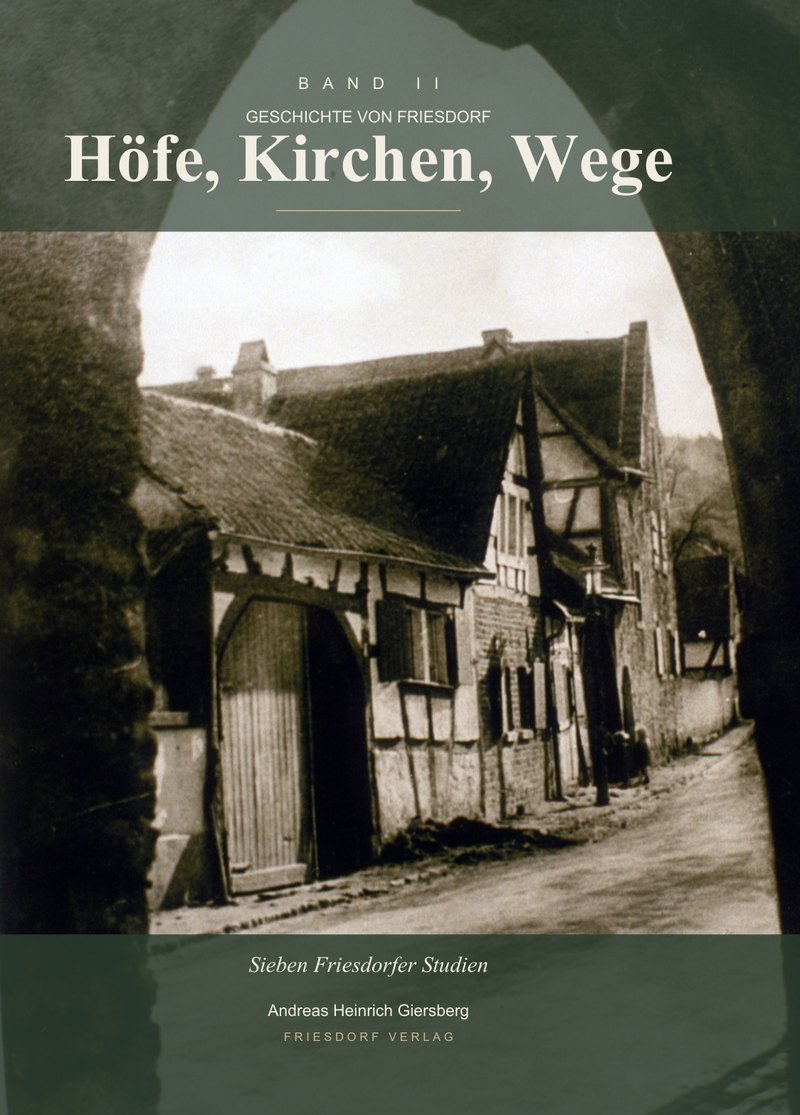
- Format
- Hardcover, 17 × 24 cm
- Pages
- 364
- Illustrations
- 69, in colour
- Notes
- some 770
- Binding
- hardback
- Availability
- available soon
Available soon · Vol. II
Höfe, Kirchen, Wege
Band II – Sieben Friesdorfer Studien (Farms, Churches, Paths – Vol. II: Seven Friesdorf Studies)
Seven places and themes in which Friesdorf's history can be traced in particular detail — each study can be read on its own.
The Klufterhof, for centuries a farm of Heisterbach Abbey, and the tower house, whose Romanesque core is dated to the 12th century. The Gothic Hochkreuz (High Cross), painted by William Turner in 1817 and moved in 1956/57 when the B 9 road was widened. Rock cellars, brewery and Arndtruhe along the Klufterbach stream. The Pützberg with its alum works and the Annaberg estate, where in 1874 phylloxera was officially confirmed for the first time in the German Empire. The churches, from the Klufter chapel and St. Servatius to the Protestant Pauluskirche. And viticulture, attested since Carolingian times, which shaped Friesdorf until the late 19th century.
It is based on charters, files and maps from the Landesarchiv NRW, the Bonn City Archives and the parish archives, the cartularies of the monasteries and foundations and the historical Bonn daily press. Some 800 notes document the information, and 73 illustrations show the places.
Volume I, „Von den Römern bis heute“, tells the history of Friesdorf as a continuous narrative.
Price to follow · We will announce the price and ISBN as soon as the volume is available.
Look inside
Browse with the arrows, by swiping or with the arrow keys · click to enlarge
1/8
Village coat of arms and title page · pp. 2–3
Table of contents Vol. II · 7 chapters · translated
Chapter 11The Klufterhof – the history of a farm from 956 to today13
- 11.1 Sources and state of research13
- 11.2 History of the name – from Crucht to Klufterhof16
- 11.3 Roman prehistory and Frankish settlement17
- 11.4 Gandersheim estate, Heisterbach purchases and the Severin estate17
- 11.5 The advocacy and its redemption 1200 / 124522
- 11.6 The final sale of 1318 – 50 pounds of Tournois of the King of France24
- 11.7 Viticulture and wine dues (13th to 18th century)27
- 11.8 The Klufter chapel – Mass foundation, lawsuit, demolition in 179429
- 11.9 The Klufterhof as a regional administrative and collection centre31
- 11.10 The Heisterbach lease of 30 May 1791 (charter Schmitz no. 779)32
- 11.11 The French period – 1794 as the real turning point35
- 11.12 The succession of tenants Offenberg–Birkhäuser–Peters (since 1722)40
- 11.13 Around 1900 – Josef Peters, brickworks, incorporation and research station44
- 11.14 The Klufterhof in the 20th century – an eyewitness account46
- 11.15 Owners, tenants and contracting parties of the Klufterhof51
Chapter 12The tower house of Friesdorf – a Romanesque noble seat from the 12th century to today61
- 12.1 Sources and state of research61
- 12.2 History of the name – from „tower“ to „tower house“63
- 12.3 The building – Romanesque secular architecture of the 12th century64
- 12.4 High Middle Ages – the knights of Friesdorf and the Turmhof69
- 12.5 Late Middle Ages – the Schall von Bell as first feudal holders (1387–1591)71
- 12.6 Early modern period – von Horst, Hochkirchen, Radius, Embaven (1599–1776)72
- 12.7 The Counts of Belderbusch – the end of the feudal structure (1776–1794)76
- 12.8 The Boeselager period and the middle-class owners (1834 to today)79
- 12.9 20th and 21st centuries – residential building and listed monument83
- 12.10 The tower house in the Friesdorf coat of arms, 200486
- 12.11 Glossary – historical technical terms87
Chapter 13The Hochkreuz: a Gothic wayside cross on the Friesdorf boundary (14th century to today)99
- 13.1 Sources and state of research99
- 13.2 Location and topography101
- 13.3 Dating and founder102
- 13.4 The monument – architecture and iconography104
- 13.5 Foundation legends – three legends and a popular belief107
- 13.6 From the late Middle Ages to the Truchsess War (1340/60–1589)110
- 13.7 Decay in the 17th and 18th centuries111
- 13.8 Rediscovery in Rhine Romanticism (1783–1850)112
- 13.9 Conservation and restoration in the 19th and 20th centuries114
- 13.10 The High Cross and Friesdorf – identity and transition119
- 13.11 From wayside cross to federal quarter – naming of the district and urbanisation120
- 13.12 Present state – the double existence of original and replica121
Chapter 14Brewery, rock cellar, Arndtruhe: Friesdorf brewers and a forgotten Bonn landmark (1812 to today)129
- 14.1 Overview129
- 14.2 Topography: the Klufterbach valley, Servatius chapel, Lültgen cross of 1641130
- 14.3 The rock cellar and the inscription „N. Wolter, Bonn. 1812.“133
- 14.4 The Wolter family: Bonn brewers, Beuron archabbots, Friesdorf innkeepers140
- 14.5 The brewery „Im Felsenkeller“ 1851 to 1886146
- 14.6 Transition to an inn (1886 to 1902/03)156
- 14.7 Hotel-Restaurant „Arndtruhe“ and the Arndt Museum (1903/1909 to 1945)158
- 14.8 Decline and destruction in 1945164
- 14.9 Afterlife: the „An der Arndtruhe“ housing estate, the rock cellar, the Woltersweiher pond165
- 14.10 The painter Toni Wolter (1875–1929)167
Chapter 15Mining on the Pützberg181
- 15.1 Prehistory: mining on the „Putzbergh“ before 1580182
- 15.2 From peat cutting to the making of lignite briquettes (Klütten) (1675–1800)183
- 15.3 Auction of 1807, concession of 1813 and mining tax of 1814184
- 15.4 What is alum? Chemistry, use, significance190
- 15.5 The production process190
- 15.6 The works: open pits, leaching, crystallisation buildings191
- 15.7 The owners 1807–1890197
- 15.8 Jakob Nöggerath – geologist, initiator, university professor202
- 15.9 The manager Wilhelm Pfaffenberger203
- 15.10 Social history: workforce, child labour, „Friesdorfer Klütten“204
- 15.11 Relocation 1841/45, the Godesberg works and the end in 1886/1890206
- 15.12 Afterlife: experimental estate, interim period, Pfeifer & Langen211
- 15.13 What can be seen today?214
Chapter 16The churches of Friesdorf – St. Servatius in the village, the Klufter chapel at the Klufterhof and the Protestant Pauluskirche231
- 16.1 Overview and sources231
- 16.2 Early roots in the Cassius foundation (9th–13th century)232
- 16.3 Friesdorf's two Servatius churches (late Middle Ages to 18th century)234
- 16.4 The building file of 1747/48 and the Species Facti235
- 16.5 The Baroque parish church at the tower house (1748–1888)237
- 16.6 Parish priest Heinrich Merck (1836–1853) and his treasure of relics238
- 16.7 The neo-Gothic new church of St. Servatius (1886–1891)240
- 16.8 The Klufter chapel – the Servatius pilgrimage at the Klufterhof245
- 16.9 St. Servatius in the 20th and 21st centuries247
- 16.10 Protestant Friesdorf – the Maarhaus of 1937 and the Pauluskirche of 1960250
- 16.11 Monastic network and landholdings elsewhere252
- 16.12 The parish and congregation today253
Chapter 17Viticulture in Friesdorf269
- 17.1 The beginnings: from Roman times to 1203270
- 17.2 Churches and monasteries as wine lords272
- 17.3 Where the vineyards lay280
- 17.4 Grape varieties and winemaking286
- 17.5 Work, dues and yields291
- 17.6 Reputation and prices296
- 17.7 Decline in the 19th century300
- 17.8 The phylloxera of Annaberg302
- 17.9 The end and what remains307
- 17.10 Appendix: old measures, weights and coins309
AppendixEstate, sources and index
- On the local-history estate of Andreas Giersberg senior (1933–1985)327
- Sources and literature328
- Acknowledgements351
- Index352
Each chapter ends with a summary, a timeline and the notes.
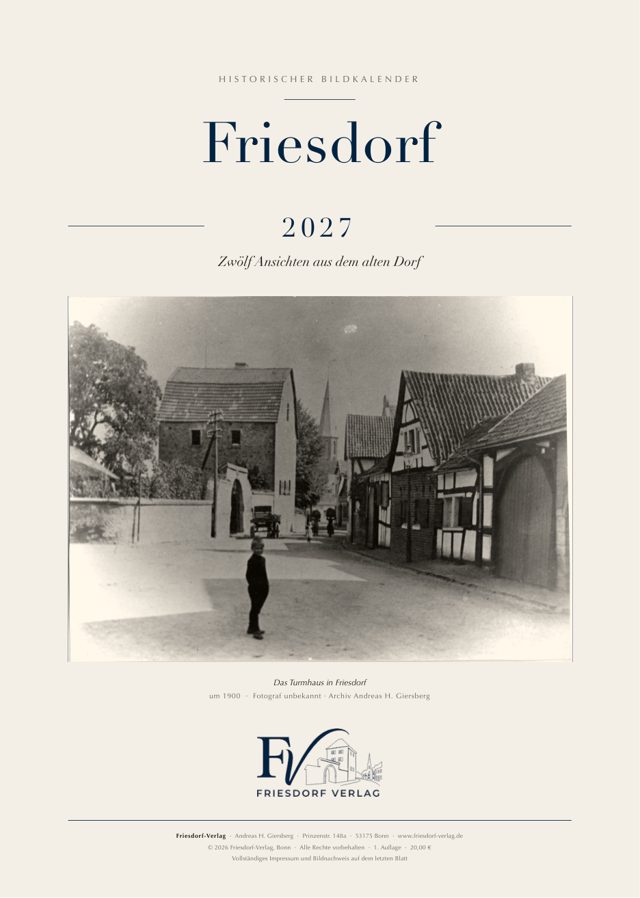
- Format
- DIN A4 (210 × 297 mm), portrait
- Extent
- 14 sheets
- Illustrations
- 12 historical photographs
- Texts
- an explanation for each view (in German)
- Binding
- wire-o binding
- Available
- from 1 November 2026 · 1st edition in a small print run
Historical picture calendar
Friesdorf 2027
Twelve views of the old village
A year of Friesdorf as it used to be: twelve historical photographs from the archive of Andreas H. Giersberg lead through the old village — from the tower house in the snow around 1910 and the interior of St. Servatius to the bell bazaar of 1921. Each view comes with an explanatory text (in German); the pictures are taken from the book Historisches Friesdorf.
The calendar shows public holidays and school holidays in North Rhine-Westphalia, local customs and carnival days.
Available from 1 November 2026: The calendar is published in a small print run and can be ordered via this website of Friesdorf-Verlag (sent by post, plus postage: 1 calendar €2.50, 2–3 calendars €3.50) — locally also at the restaurant „Im Setzkasten“, Joseph-Roth-Straße 90, Bonn-Friesdorf, while stocks last. We take orders via the contact form.
€15.00 plus postage · while stocks last
Look inside the calendar
Cover and seven monthly pages · click to enlarge
1/8
Cover · sheet 1

- Format
- Hardcover, landscape 29.7 × 21 cm
- Pages
- 128
- Illustrations
- more than 120, colour and black-and-white
- Texts
- an explanatory text for each picture (in German)
- Binding
- hardback
- Availability
- 1st edition 2025 (out of print) · 2nd edition available soon
Picture book · Available soon
Historisches Friesdorf
Alte Ansichten eines Bonner Ortsteils (Old Views of a Bonn District)
Andreas Giersberg's first book shows, in more than 120 colour and black-and-white illustrations, what Friesdorf used to look like — from the rural village character of the 19th century to the new housing estates of the post-war period. All pictures come from the author's private collection and are accompanied by explanatory texts.
The book was published in 2025 by BonnBuchVerlag (hardcover, 128 pages) and is currently out of print. The second edition from Friesdorf-Verlag will be available soon.
Available soon: the second edition from Friesdorf-Verlag — we will gladly let you know as soon as you can order it.
Look inside
Browse with the arrows, by swiping or with the arrow keys · click to enlarge
1/8
Title page · p. 1
Reservations & questions
Stay informed
As soon as prices and ways of ordering are fixed, we will announce them here. We will gladly notify you personally — just write to us.
To the contact form (in German)or by e-mail to info@friesdorf-verlag.de