Timeline

Two thousand years of Friesdorf

From the Roman estate at the Arndtruhe to the present: 100 stations of Friesdorf history, each documented in the two volumes of Geschichte von Friesdorf. The Nazi era is covered in more detail, with 28 stations.

Move the mouse over a station to find out more.

Vol. I · Chapter 1 · 2 stations

Roman times until 500

Friesdorf in Roman times

  1. 2nd century AD at the latest

    A Roman estate at the Arndtruhe

    From the 2nd century at the latest, a Roman villa rustica stood on the middle terrace above the Klufter valley – an estate of some 3,000 m² in the supply belt of the Bonn legion.

    Vol. I · Chapter 1

    At that time Friesdorf lay in the south of the province of Germania inferior, about six kilometres south of the Bonn legionary fortress. Since 1876/86 the villa has been investigated in five excavations. It had a bath complex, a central courtyard, a half-timbered upper storey and probably a cellar. A special piece is a fluted column of red sandstone, 2.04 metres high, which once stood in the garden of the Arndtruhe and later went to the Landesmuseum Bonn.

  2. AD 241–244

    A votive stone for Emperor Gordian III

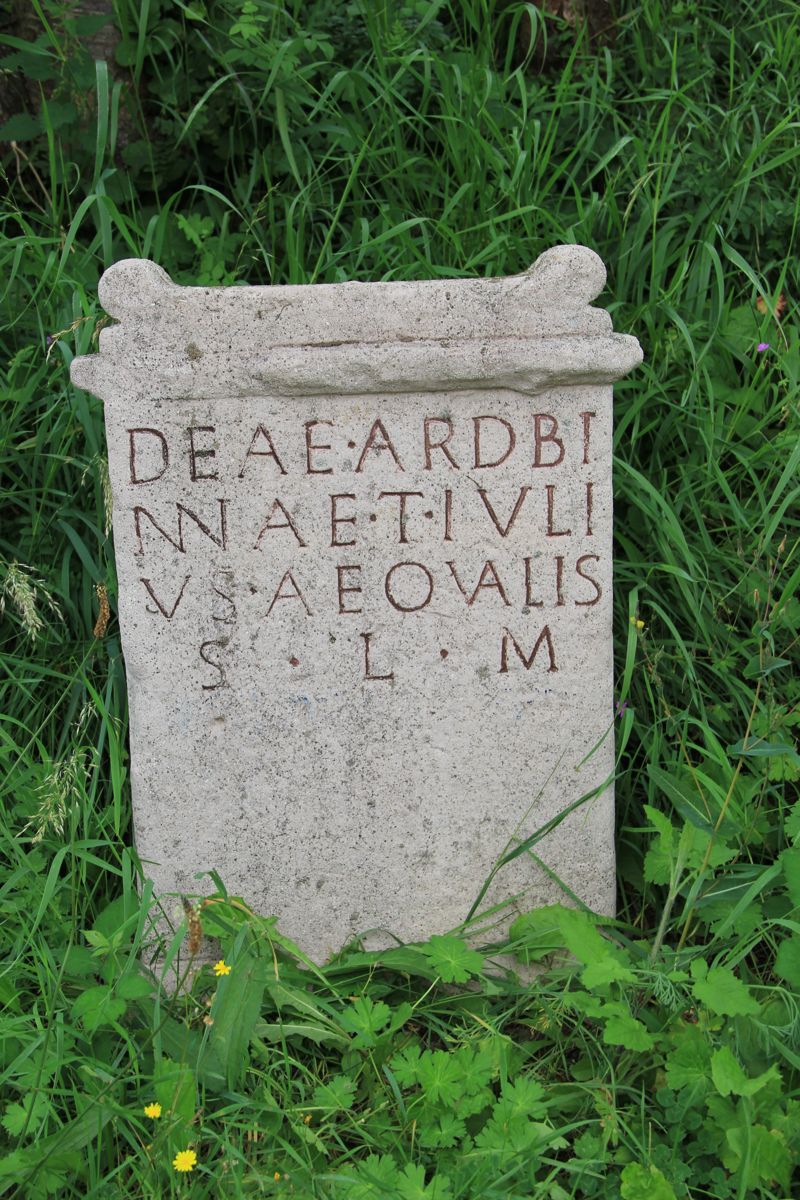
    Oclatius Sacerdos, the highest-ranking centurion of the Bonn legion, Legio I Minervia, has a votive stone erected for the well-being of Emperor Gordian III and Empress Sabinia Tranquillina.

    Vol. I · Chapter 1

    The block of Berkum trachyte measures 92 × 80 × 28 centimetres and was probably the base of a statue. It was dedicated to the Fortuna of the legion and, according to modern reconstructions of the heavily weathered inscription, to other deities as well. Centuries later it served as the altar of the Klufter chapel. Wilhelm Dorow described it in 1823; today it stands in the LVR-LandesMuseum Bonn. That the chapel stood on a Roman sanctuary has not been proven.

    A comparable Roman votive stone from the Lower Rhine – not the Friesdorf stone.
    A comparable Roman votive stone from the Lower Rhine – not the Friesdorf stone. Photo: Axel Kirch, CC BY-SA 4.0

Vol. I · Chapter 2 · 4 stations

Early Middle Ages 500–1000

Friesdorf in the early Middle Ages

  1. 7th century

    Frankish graves at the Frankengraben

    On the edge of the old village centre lies a Frankish cemetery. The Landesmuseum Bonn dated a grave with a broad seax, a spearhead and a knife to the 7th century.

    Vol. I · Chapter 2

    According to local tradition, finds came to light there as early as 1881 and 1926/27; in 1960 a grave with a fragment of a silver arm ring and a clay spindle whorl, and in 1969/70 further graves, some with stone surrounds. In the excavation reports the street is still called Kirchhofgrabenweg. The place name Fritigesdorp, „village of Fritigis“, goes back to a Frankish personal name; the settlement probably arose in the 6th or 7th century.

  2. 722/23

    A possible first mention: Fritigestorp

    In a note listing place names from the cartulary of the Bonn Cassius foundation, Friesdorf appears as „Fritigestorp“. Levison dates the mention of Godesberg in the same note to 722/23 – it is possible, but not certain, that Friesdorf was already named then. Friesdorf is securely attested only with Alvard's donation of 819–841.

    Vol. I · Chapter 2

    The charter itself is lost. All that survives is an extract with the place names, which the Cologne patrician Johann Helman (d. 1579) copied from the cartulary of the Bonn Cassius foundation – before its archive was largely destroyed in the Truchsess War in 1587. The extract begins with the words „In pago Bonnensi in villa quae dicitur Fritigestorp“: in the Bonn district, in a village called Fritigestorp.

  3. 819–841

    Alvard donates a Friesdorf vineyard

    The layman Alvard gives the Bonn church of St. Remigius a vineyard „in the district called Fristorp“ – the oldest record of viticulture in Friesdorf.

    Vol. I · Chapter 2

    The charter is the oldest mention of Friesdorf surviving in full. It is dated by the term of office of Archbishop Hathabald of Cologne (819–841). The church of St. Remigius that received the gift depended on the Bonn Cassius foundation; with his gift Alvard secured perpetual remembrance in the liturgy. Viticulture remained characteristic of the Friesdorf valley slope well into the modern era; field names such as „hinter Crochter Capellen“ or „Moersgrube“ recall it.

  4. 21 April 956

    Otto I confirms Gandersheim's possession of the Crucht estate

    A charter of Otto I confirms the Saxon women's foundation of Gandersheim in its possession of Crucht – the first certain mention of the later Klufterhof.

    Vol. I · Chapter 2

    The foundation in the Harz came into possession of the estate through King Arnulf (887–899): the charter of 956 reports that he had transferred to Gandersheim everything he owned „in Cruft“; no charter of Arnulf himself survives. The only things not supported are the year 852, which is sometimes given, and a confirmation by name by Otto I in 947. On 22 June 1206 Pope Innocent III again confirmed the foundation's possessions of Crucht, Calchem and Bliterstorph with their churches and vineyards.

Vol. I · Chapter 3 · 9 stations

High Middle Ages 1000–1350

Friesdorf in the high Middle Ages

  1. 1139

    Wolframmus de Friderichistorp

    Among the ministeriales witnessing a charter of Archbishop Arnold I of Cologne appears Wolframmus de Friderichistorp – the oldest known bearer of the Friesdorf name of origin.

    Vol. I · Chapter 3

    With him begins a series of charters in which members of this family of lesser nobility appear over two centuries: as witnesses, as advocates over estates in Crucht and Plittersdorf, and as tenants of the Cologne foundation of St. Andreas. Whether two early benefactors of the convent of Rolandswerth on Nonnenwerth belonged to the family is open; their name forms may also refer to Fritzdorf. The last bearer of the knightly title, Rutgerus, is attested in 1328. Their seat may have been the tower house.

  2. 12th century

    The tower house – a Romanesque building

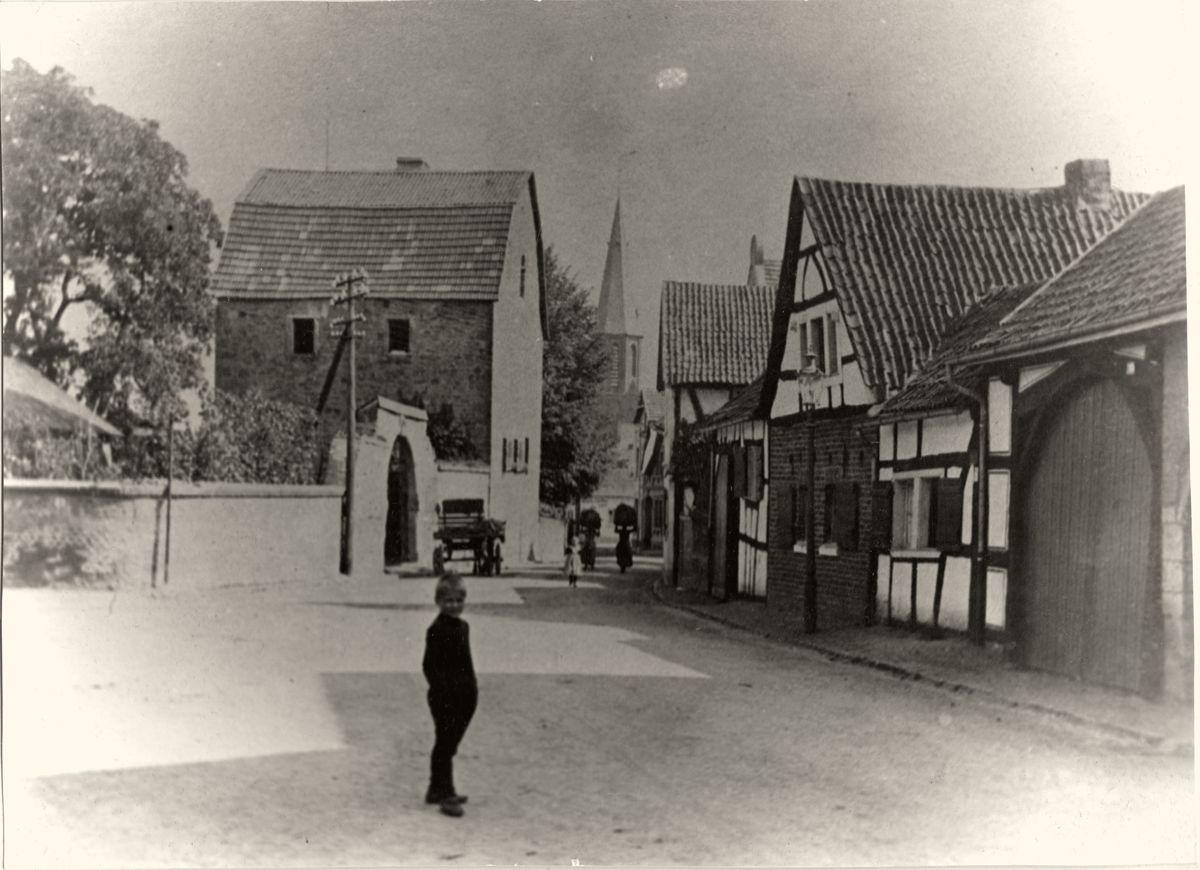
    According to the inventory of art monuments, the tower house on Annaberger Straße, known locally as „Die Burg“ (the castle), dates from the 12th century; it may have been the seat of the knights of Friesdorf.

    Vol. I · Chapter 3probable

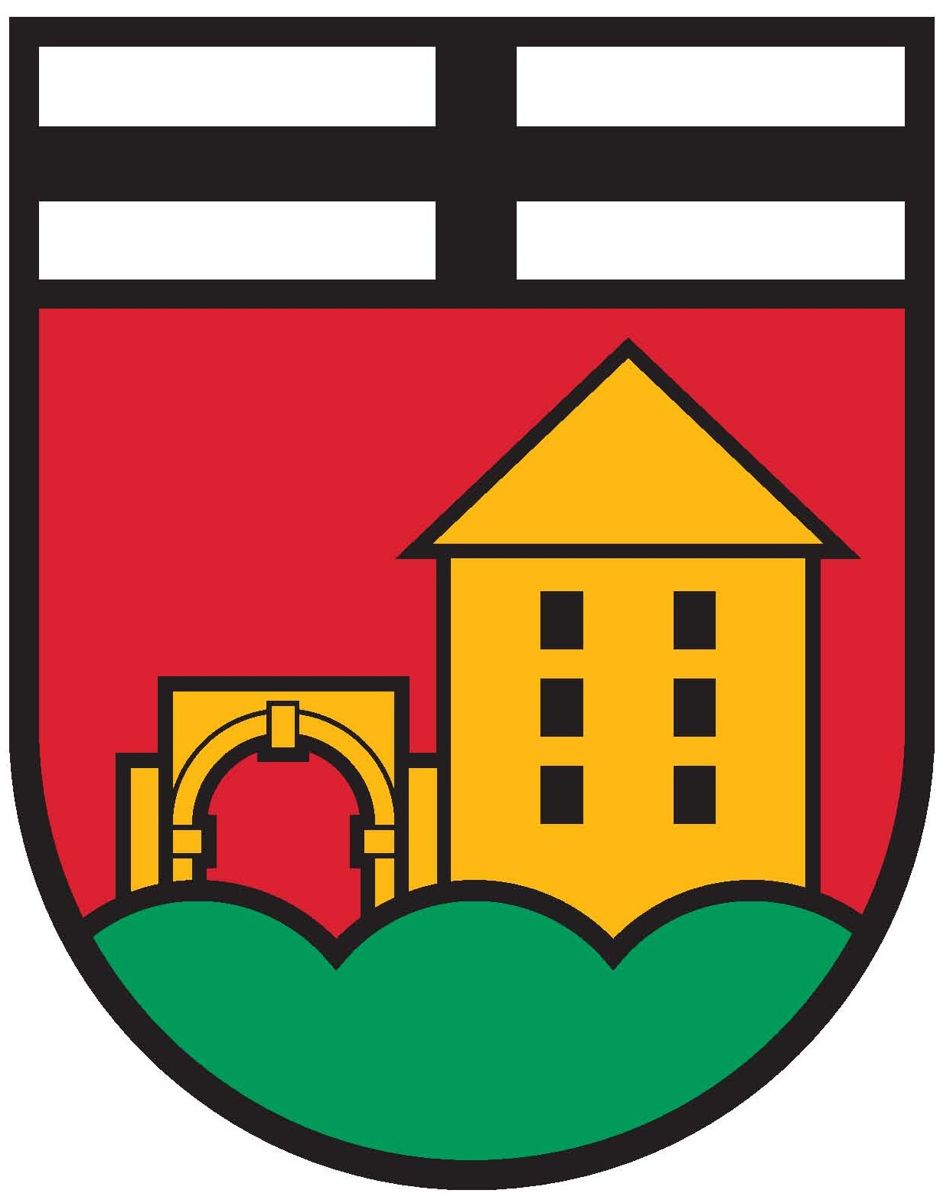
    Paul Clemen described the building as Romanesque: rubble stone, basalt in the foundations and plinth, round-arched windows with tuff surrounds. In the cellar he found remains that appear to come from an even older building. The date 1777 on the gateway marks a later remodelling, not a new building. From 1387 the house was a fief of Siegburg Abbey. The village coat of arms introduced in 2004 shows the tower house.

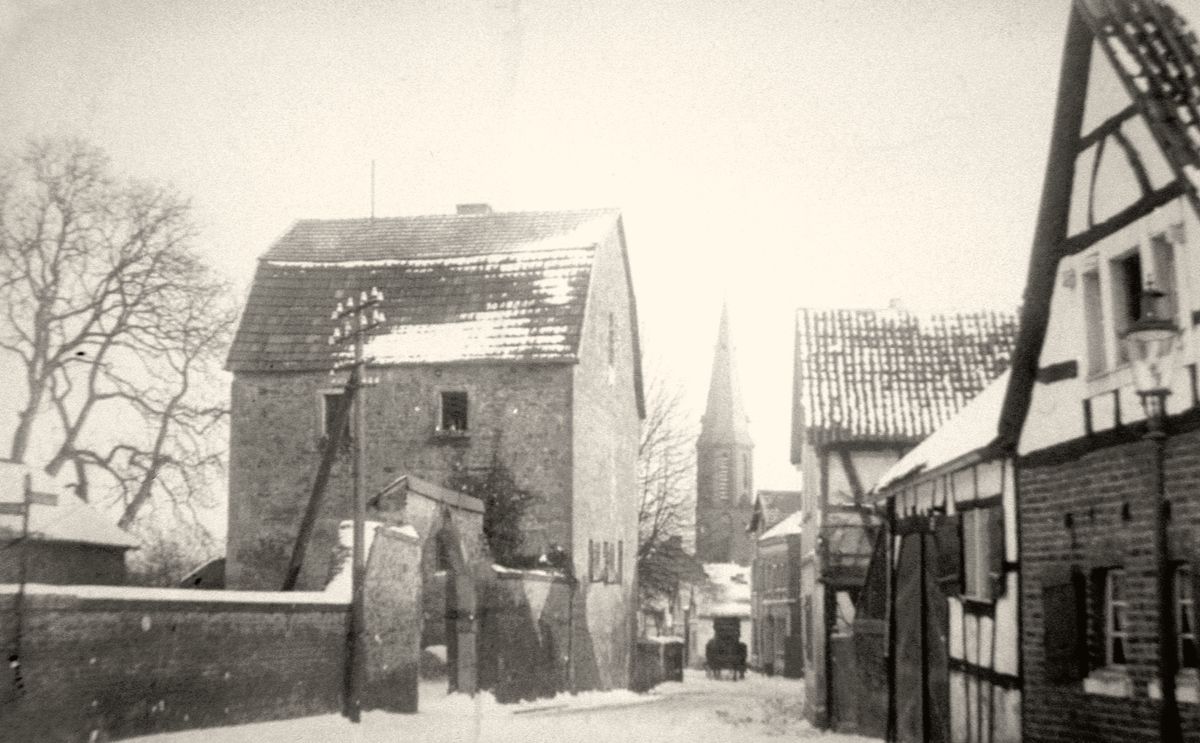
    The tower house in Friesdorf, c. 1900.
    The tower house in Friesdorf, c. 1900. Archiv Andreas H. Giersberg
  3. 1167

    A neglected estate is let anew

    Provost Conrad of the Cologne foundation of St. Severin finds a neglected estate in „Friderichesdorp“ and installs two tenants. Whether this estate became part of the later Klufterhof is open.

    Vol. II · Chapter 11

    Each autumn Heidenricus and Bertheit each had to deliver two ohms of wine „of the best that grows on this estate“ to the brothers' cellar. The charter is the oldest one concerning Friesdorf in the Heisterbach cartulary, written 22 years before Heisterbach Abbey was founded. The monastery's archivists later filed it under the Klufterhof. According to the wording of the exchange charter of 1203, the estate passed to the Bonn church, not to Heisterbach.

  4. 1219–1223

    Nine years under the ban: a miracle story

    The Heisterbach monk Caesarius tells in his „Dialogus miraculorum“ of the inhabitants of the Cruchterhof, who are said to have been excluded from the church although innocent.

    Vol. I · Chapter 3

    For nine years, he writes, they patiently stayed away from church; when shopping they silently laid down the money and pointed at the goods. During this time, according to Caesarius, no one was born there and no one died. As a factual account the miracle story is of no use. But it shows that the farm was known at Heisterbach Abbey around 1220 and that its inhabitants were subject to the Bonn clergy.

  5. 11 May 1244

    A wine farm for the Cologne foundation of St. Andreas

    The Cologne foundation of St. Andreas leases a house, vineyards and fields in Friesdorf to the knight Hermann of Friesdorf and Antiphona – in return for two fuder of „better wine“ a year.

    Vol. II · Chapter 17

    By the Cologne measure, two fuder are about 1,750 litres. The foundation supplied the barrels and had them delivered in Plittersdorf or at the harbour „Kaldenhausen“; from there the Friesdorf wine went down the Rhine to Cologne. In 1328 the foundation leased the farm to seven tenants; it included „a vineyard on the hill and one opposite the church“. The press house and cellar of the old farm were to remain standing.

  6. October 1245

    The knight Wigand gives up the advocacy

    The knight Wigand of Friesdorf returns the advocacy over Crucht to his feudal lord by casting a straw, an old legal gesture. With this the farm is completely free of advocacy.

    Vol. II · Chapter 11

    The feudal lord, Lothar of Wickrath, immediately passed the advocacy to Heisterbach Abbey – for eight ohms of wine a year in perpetuity. As early as 1200 Heisterbach had redeemed the advocacy rights of Heinrich of Friesdorf. For the knightly family the step meant the loss of its most important economic anchor in the district. Heisterbach had held the farm itself since 1207 as a fief of the Gandersheim foundation.

  7. 1 May 1318

    Sold for 50 pounds of French Tournois

    Abbess Sophia of Gandersheim finally sells the Cruchterhof to Heisterbach Abbey – for 50 pounds of large Tournois of the King of France.

    Vol. II · Chapter 11

    Since 3 February 1207 Heisterbach had farmed the estate as a fief in return for annual wine dues; now the abbey became its owner and remained so until secularisation. According to the wording of the charter, Gandersheim had already used the proceeds to buy the neighbouring castle of Gandersheim – money from the Rhineland thus flowed into the foundation's Saxon heartland. That both sides reckoned in French silver currency shows how the Rhineland was integrated into European payment systems.

  8. Mid-14th century

    A Gothic cross on the military road

    Where the military road from Bonn to Koblenz crosses the path from Friesdorf to Plittersdorf, the Hochkreuz (High Cross) is built. Its architectural forms belong to the Gothic of the mid-14th century.

    Vol. II · Chapter 13probable

    Tradition attributes the foundation to Archbishop Walram of Jülich of Cologne (1332–1349) – based solely on a chronicle printed in 1499; no independent source for this is known. The trachyte cross, almost eleven metres high according to Paul Clemen, is first mentioned with certainty in 1445. Until it was moved in 1956/57 it stood within the Friesdorf boundary. Legends tell of atonement for a bloody deed, for instance by a Friesdorf nobleman „von Hochkirchen“ – none of this is historically documented.

  9. 28 January 1349

    The last trace of the Friesdorf family

    Bela, daughter of the late Dederich van Vriestorp, and her daughter Metze sell a hereditary rent to a citizen of Bonn. It is the last mention of the name of origin; whether Bela's family belonged to the knights of Friesdorf is open.

    Vol. I · Chapter 3

    Among the properties encumbered were a vineyard „in der Marvlachten“ and a house in Friesdorf – where the „Marvlachten“ lay is no longer known today. The charter names no male heir; no knight of Friesdorf appears after 1328. In 1349 the plague reached the Rhineland. Whether it contributed to the extinction of the family cannot be determined without further sources.

Vol. I · Chapter 4 · 7 stations

Late Middle Ages 1350–1600

Friesdorf in the late Middle Ages

  1. c. 1300

    Friesdorf in the Liber valoris

    In the „Liber valoris“ of the archdiocese of Cologne, a register of the archdiocese's churches compiled around 1300, Friesdorf is listed as a parish („Crusty et Vrytzdorp“). A separate chapel „zu Erucht“ is first named in the local literature, for 1378.

    Vol. II · Chapter 16

    For centuries there were two churches in Friesdorf dedicated to St. Servatius: the parish church at the tower house in the middle of the village and the chapel at the mouth of the Klufter valley. The chapel was the destination of a pilgrimage on St. Servatius' day, 13 May. Behind it, in 1551, lay a quarter of a vineyard belonging to Heisterbach Abbey („hinder Crochter capellen“).

  2. 1387

    Johann Schall von Bell receives the Turmhof

    The tower house passes as a fief of Siegburg Abbey to Johann Schall von Bell – the first known enfeoffment after the knights of Friesdorf disappear.

    Vol. I · Chapter 4

    According to Berchem, Johann was a combative man: in 1415 he was feuding with Christian von Zwingenberg, and in 1419 he moved with his son and nephew against the city of Cologne, whose mercenaries then burned down his castle house of Vorst near Frechen. He is said to have died in 1421. The farm remained with his family for generations and was a Siegburg fief until secularisation.

  3. 3 May 1549

    Siegburg sells its rights in the Kottenforst

    In Poppelsdorf, Siegburg Abbey sells its forest rights in the Kottenforst to the Archbishop of Cologne. The Friesdorf noble estates remain Siegburg fiefs.

    Vol. I · Chapter 4

    The Turmhof and the Plakenhof were Siegburg male fiefs; their holders belonged to the „Viermänner“, the four vassals of the abbey with rights in the Kottenforst – Friesdorf provided two of them. The sale left these fiefs untouched: as late as 1777 the abbey issued a letter of enfeoffment for the Turmhof.

  4. 2 November 1562

    Six Friesdorf men lay out new vineyards

    Peter Scheefer, Lentzen Johan, Peter Murrer, Tewes Schwalff, Peter Aloffs and Johan, son of the tall Telen, receive heath and scrubland to turn into vineyards.

    Vol. II · Chapter 11

    The land lay „oben der Croichter kirchen an der Steinkoulen“, above the Klufter chapel near a stone pit. The six men had to turn it into vineyards within four years and pay eight Raderalbus per quarter each year at Martinmas to the abbey's Cruchterhof. The charter names six Friesdorf men at once; individual inhabitants are attested by name even earlier.

  5. 7 June 1580

    First mining grant on the „Putzbergh“

    Archbishop Gebhard Truchseß von Waldburg grants the Cologne citizens Friedrich Hutten and Philipp Fuerde mines „bey vnnserm Dorff Friestorff In dem Putzbergh“ (near our village of Friesdorf on the Putzbergh).

    Vol. II · Chapter 15

    The charter is the oldest record of mining on the Pützberg, more than two centuries before the usual date of 1807/09. It reports that mines had already been started there under one of Gebhard's predecessors but had then been left unworked. Its list of ores follows the usual formula; alum, vitriol and hard coal were indeed later extracted on the Pützberg. Whether Hutten and Fuerde actually mined there is open.

  6. 1583–1589

    The Cruchterhof burns down in the Cologne War

    In the Truchsess or Cologne War the Cruchterhof burns down – like Heisterbach Abbey and its farms in Königswinter and Plittersdorf. The exact year has not been handed down.

    Vol. I · Chapter 4

    Archbishop Gebhard Truchseß von Waldburg wanted to make the Electorate of Cologne Protestant; troops of both sides marched through the land. In 1583 the Godesburg was blown up and stormed, and in 1587/88 there was fighting around Bonn. The printed war sources do not name Friesdorf itself. The fire is attested by a Heisterbach charter of 1598: the farms had been „in grundt abgebrandt“ (burnt to the ground). When the farm was rebuilt has not been handed down.

  7. 1595–1601

    A Friesdorf squire in the Düsseldorf court scandal

    Dietrich von Hall zu Uphoven, son of a squire with a farm in Friesdorf, is accused of an affair with Duchess Jakobe of Baden – in the middle of a power struggle at the Düsseldorf court.

    Vol. I · Chapter 4

    The Cologne chronicler Hermann Weinsberg recorded the rumour in 1595. Jakobe died in 1597 in unexplained circumstances. In interrogations in 1599 and 1601 Dietrich admitted the adultery; according to the files it cannot be ruled out that the confession was extorted. He was sentenced to 5,000 gold guilders, for which his father had to stand surety, and „banished from the Empire for all time“, with the condition that he travel to India or America.

Vol. I · Chapter 5 · 7 stations

Baroque & Enlightenment 1600–1800

Friesdorf between Baroque and Enlightenment

  1. 1669

    Fire, door and pot hook: a legal ritual

    On 23 and 24 September 1669 officials of Siegburg Abbey take possession of two Friesdorf noble estates in an old legal ritual. Among the witnesses: Johann Giersberg, inhabitant of Friesdorf.

    Vol. I · Chapter 5

    A Bonn notary recorded every step at the Binsfelder Hof: the gate opened and closed, the front door unlocked and locked, a fire lit and put out, the pot hook moved, the pot taken off. The gentlemen stayed overnight; in the morning vineyards and plots followed; at the Marienforster Hof a twig was broken off a young walnut tree. In this way Siegburg Abbey sought to enforce its feudal rights. Johann Giersberg is the oldest known Friesdorf Giersberg with a first name; the surname already appears in the tax lists of 1666/67: „Hall nun Giersberg“ (Hall, now Giersberg).

  2. c. 1675

    Looking for coal, finding peat

    Around 1675 Elector Maximilian Heinrich has prospecting for hard coal carried out on the Pützberg, today's Annaberg. Only peat is found – the work is stopped.

    Vol. I · Chapter 5probable

    Wood from the Kottenforst could only be cut with the Elector's permission. Mines on the „Putzbergh“ are attested as early as 1580. Around 1750 the convent of Marienforst had peat and lignite dug on the same hill, bringing in workers from Liblar; because of the low yield it soon gave up this attempt as well. The search for mineral resources on the Pützberg finally led to the alum works in 1809.

  3. 1748–1750

    A new nave on the old tower

    From 1748 to 1750 the dilapidated Friesdorf parish church next to the tower house receives a new nave; the old Romanesque tower remains standing.

    Vol. I · Chapter 5

    The parish gave 400 thalers and parish priest Leutzen 120 malters of Kirchheim lime; the rest of the costs was borne by the Bonn Cassius foundation. In the churchyard stood a tall stone cross of 1742, erected by the lay judge Leonardus Offenberg, tenant (Halfmann) of the Klufterhof, and his wife Anna Catarina Baugs. It remained standing when the churchyard was levelled in 1888 and today stands in the garden of the house Im Bachele 1b.

  4. 1776/1777

    The minister buys the Turmhof

    In 1776 the Electoral Cologne minister of state Kaspar Anton von Belderbusch buys the Turmhof for 10,000 thalers. The year 1777 has stood above the great gateway ever since.

    Vol. I · Chapter 5

    Siegburg Abbey issued the letter of enfeoffment on 10 January 1777. Belderbusch, the dominant politician of the Electorate of Cologne, lived in Bonn and took little care of the farm, which already had structural defects; in 1783 the property qualified him for a seat in the diet. The Turmhof carried the right to propose a parish priest to the parish – recorded for instance for 1637, 1690 and 1766. The gateway arch of 1777 is today part of the Friesdorf village coat of arms.

  5. 1794

    The Klufter chapel is demolished

    The dilapidated chapel of St. Servatius at the Klufterhof is pulled down. In the process it turns out that its altar was a reused Roman votive stone.

    Vol. I · Chapter 5

    The chapel had existed since the Middle Ages; in the 16th century the patron, the parish priest and the parish quarrelled with Heisterbach Abbey over the grain for two weekly Masses there. Pilgrims venerated St. Servatius against the „Frieseln“, a skin rash. The site remained known as the „Kapellenplatz“ (chapel square). Whether the chapel stood on a Roman sanctuary or merely reused the stone cannot be decided without an excavation.

  6. 1794

    The French arrive – the Electorate of Cologne ends

    In late autumn 1794 French revolutionary troops occupy the left bank of the Rhine. Electoral Cologne rule and the old feudal system end; in 1798 Friesdorf becomes part of the Rhin-et-Moselle département.

    Vol. I · Chapter 6

    Bonn became the chief town of an arrondissement to which Godesberg and Friesdorf belonged. The feudal tie of the Turmhof to Siegburg Abbey, more than 400 years old, had in effect lapsed. The burdens of war rose sharply; a lease for the Klufterhof dated 22 February 1798 therefore reduced the dues. After the Congress of Vienna the Rhineland passed to Prussia: from 1815 to 1904 Friesdorf belonged to the mayoralty of Godesberg in the district of Bonn.

  7. 15 July 1796

    Emergency sale for 20,000 Reichstaler – not recognised

    Hard pressed by war, plundering and the seizure of its income on the left bank of the Rhine, Heisterbach Abbey sells the Klufterhof to Elisabeth Schumacher of Bonn. The French do not recognise the sale.

    Vol. II · Chapter 11

    Since late autumn 1794 French troops had occupied the left bank of the Rhine. In the deed of sale the monastery complains of war costs, contributions and being plundered three times by the Franks. Elisabeth Schumacher paid three quarters of the price at once but received no valid title of ownership; a marginal note records: „Der Verkauf wurde von den Franzosen nicht anerkannt.“ (The sale was not recognised by the French.) With the Peace of Lunéville in 1801 and the consular decree of 1802 the farm fell to the French state.

Vol. I · Chapter 6 · 19 stations

Prussia & industry 1800–1914

Friesdorf between the Prussian era and industrialisation

  1. c. 1800

    68 Morgen of vines around the village

    In the French period the district has 68 Morgen of vineyards alongside 749 Morgen of arable land; the vines bring in about a tenth of the net yield.

    Vol. II · Chapter 17probable

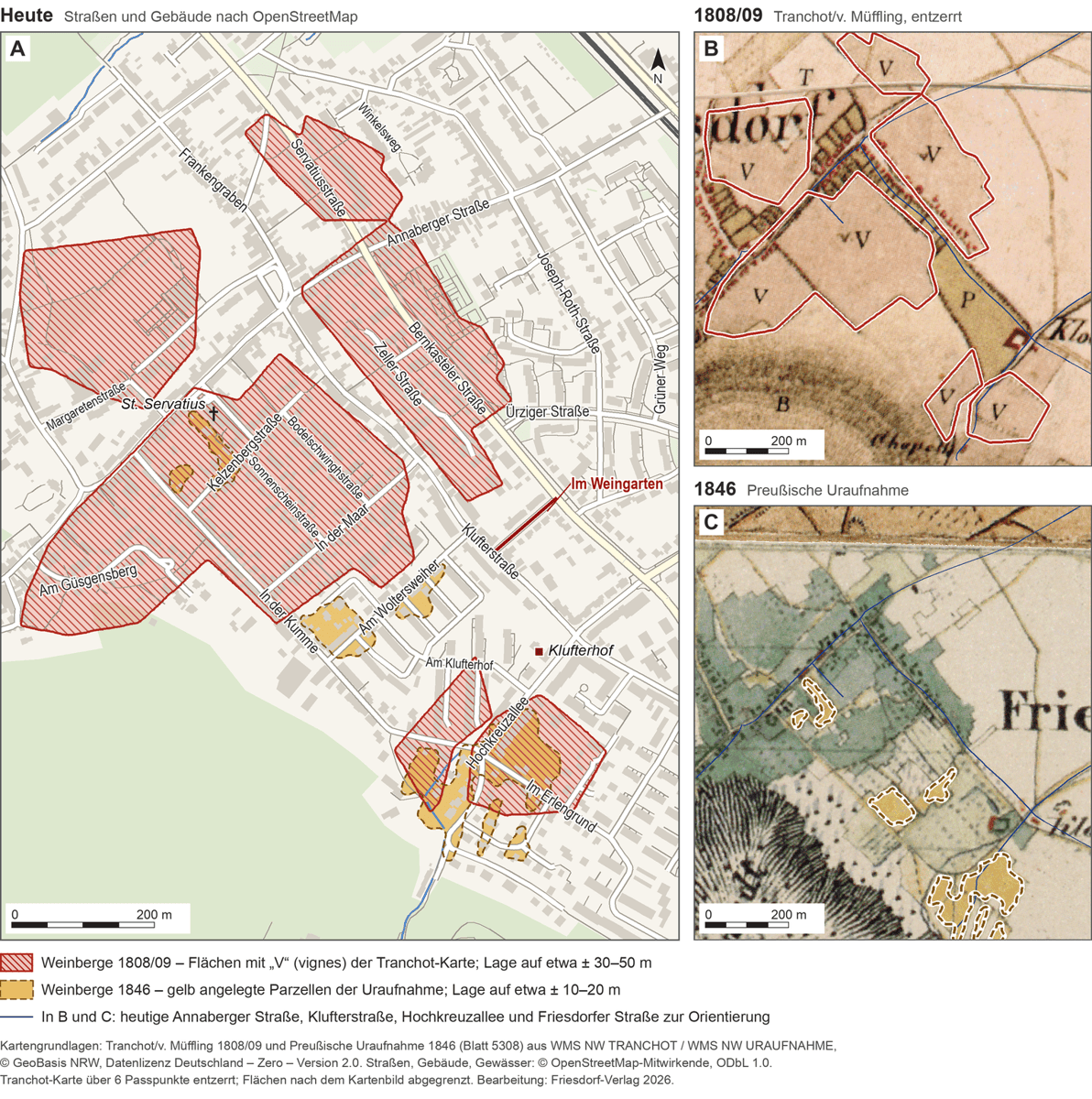
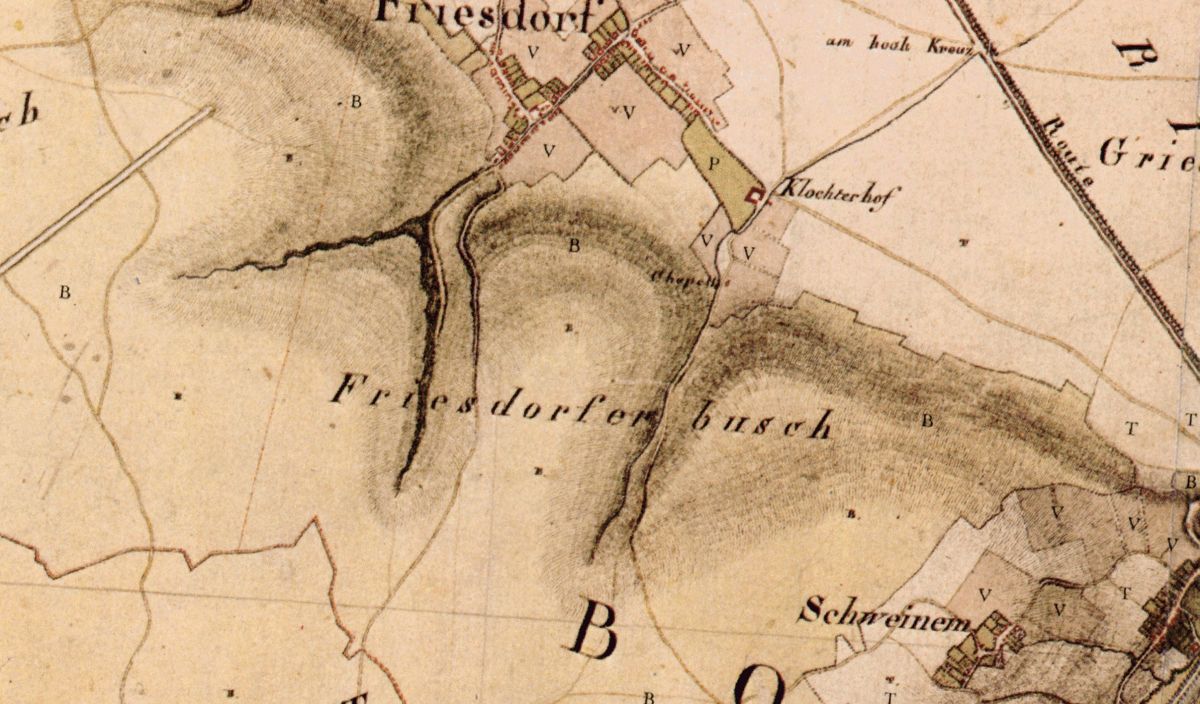
    68 Cologne Morgen are about 21.6 hectares; for 1809 the handbook of the département gives 21 hectares 54 ares. The Tranchot map of 1808/09 shows the vineyards as a continuous belt behind the houses on Annaberger Straße and Klufterstraße and south of the Klufterhof. Red wine was grown; in Bonn, Friesdorf wine traded at a higher price than wine from Kessenich in 1834. By 1864 only about four hectares were left.

    Where the vineyards lay: vineyard areas in 1808/09 (red) and 1846 (ochre) on today's map of the district.
    Where the vineyards lay: vineyard areas in 1808/09 (red) and 1846 (ochre) on today's map of the district. Maps: GeoBasis NRW, DL-DE Zero 2.0; © OpenStreetMap contributors, ODbL; adaptation Friesdorf-Verlag 2026
  2. 1802/1803

    Secularisation: the end of monastic rule

    On the left bank of the Rhine the consular decree of 9 June 1802 dissolves the monasteries; on the right bank secularisation follows the Reichsdeputationshauptschluss of 25 February 1803. Heisterbach Abbey, the manorial lord of the Klufterhof, is dissolved in 1803.

    Vol. I · Chapter 6

    Around 1800 Friesdorf had 404 inhabitants, most of whom worked as day labourers. At least 17 manorial lords and rent holders had determined their lives – none of them lived in the village. The people of Friesdorf hardly benefited from secularisation: the large properties mostly went as a whole to buyers with cash capital. The Klufterhof continued to be farmed by the tenant family Birkhäuser; when it acquired ownership has not been established.

  3. 26 March 1807

    Auction of the Pützberg: the beginning of the alum works

    Theodor Quinck of Bonn and Joseph Schmitz of Koblenz buy the Pützberg at auction for 2,200 francs. It becomes one of the four alum works of the Rhine Province.

    Vol. II · Chapter 15

    After the application for a concession of June 1808 and the trade concession of 15 August 1809, the firm Quinck & Cie. began industrial operations. The alum content of the deposit was demonstrated by the young mineralogist Jakob Nöggerath; his father Karl was partner and director of the works. With the Décret Impérial of 26 December 1813 Napoleon granted the concession over twelve square kilometres. The buyers' first names lived on in the names of the open pits „Theodorswunsch“ and „Josephs-Zufriedenheit“.

    Friesdorf and the Pützberg before the alum works were built, map survey of 1808/09.
    Friesdorf and the Pützberg before the alum works were built, map survey of 1808/09. Datenlizenz Deutschland – Zero 2.0
  4. 1817

    William Turner paints the High Cross

    In 1817, on his first journey along the Rhine, the English painter William Turner captures the High Cross – in the middle of fields, with the Godesburg in the background.

    Vol. II · Chapter 13

    The watercolour shows a column of soldiers on the Koblenzer Straße, which makes the size of the pillar visible. The rediscovery of the cross had begun with the descriptions by Eichhoff (1783) and Huepsch (1789); after journeys in 1821 and 1823 Samuel Prout spread pictures of the High Cross among English Rhine travellers. In 1829 the Oberpräsident (provincial governor) Karl von Ingersleben initiated the first conservation. Turner's sheet can be seen today in the LVR-LandesMuseum Bonn.

  5. 14 Dec. 1826

    Moll & Köhler take over the alum works

    By a contract of sale dated 14 December 1826 the lignite and alum works passes to the Cologne firm Moll & Köhler – Ludwig Ferdinand Köhler of Elberfeld and Isaak Moll, half each.

    Vol. II · Chapter 15

    The local literature had so far dated the purchase to 1828. Wilhelm Pfaffenberger had been manager of the works since 1822 at the latest; he remained so until his death in 1856. Since 1818 Köhler had owned the later Villa Simons at Im Bachele 1, which he called „Ludwigslust“. From 1841 Moll was sole owner.

  6. 1827

    Three days of dance music for the Kirmes

    In the Bonner Wochenblatt of 13 May 1827 the innkeeper Meunier invites people to the Friesdorf Kirmes (parish fair) – three days of dance music in a newly built hall. It is the oldest known record of the festival.

    Vol. I · Chapter 6

    The Servatius Kirmes for the patronal feast on 13 May was already a festival of several days, from Sunday to Tuesday, in 1827. In the following years other innkeepers also issued invitations, for instance Johann Vershoven; the Vershoven inn at the Waasem had existed since 1793. In summer there was a second, smaller Kirmes: the feast of St. Margaret around 20 July. In 1908 the steam tram ran twice as many trains on Kirmes days.

  7. 1836

    Alum works on the Pützberg with 200 employees

    At its peak in 1836 the works employs about 200 people – Friesdorf itself had some 700 inhabitants around 1830.

    Vol. II · Chapter 15

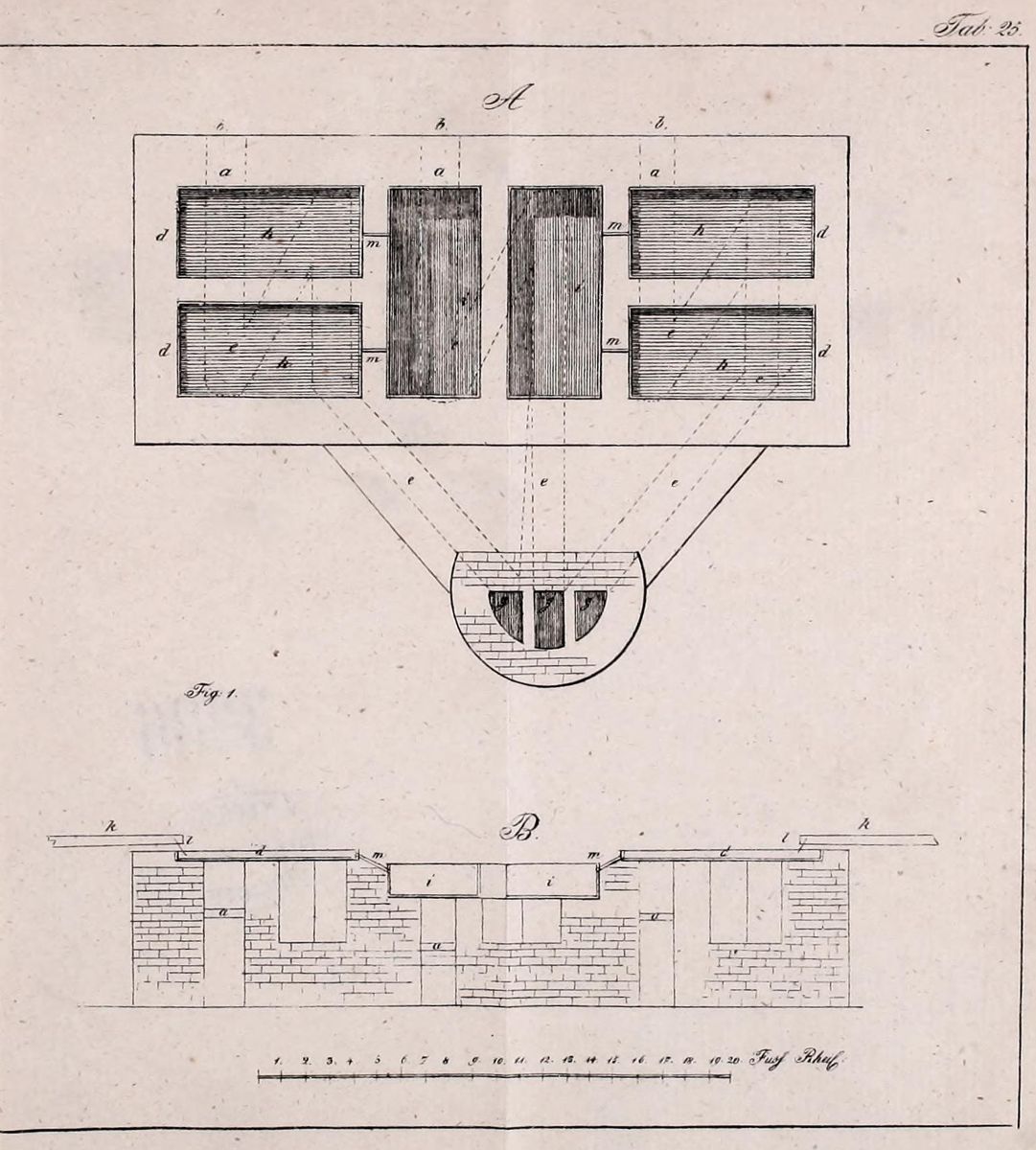
    Three open pits, each the size of a football pitch and up to ten metres deep, leaching tanks, a boiling house and „Krystallisations=Gebäude“ (crystallisation buildings) formed a large manufactory that worked without steam power; the works was one of the four leading alum works of the Rhine Province. From the earthy lignite people also formed Klütten, hand-moulded fuel bricks. The neighbouring people of Dottendorf thereupon called the people of Friesdorf „Friesdorfer Klütten“.

    Alum boiling equipment at Friesdorf, 1824.
    Alum boiling equipment at Friesdorf, 1824. public domain
  8. 20 November 1842

    The Wolter brothers at the rock cellar

    An advertisement in the „Bonner Wochenblatt“ offers rubble stone „am Felsenkeller bei Friesdorf“ (at the rock cellar near Friesdorf), signed „Gebr. Nicola u. Anton Wolter, Bierbrauer“: the brothers already had the rock cellar at their disposal in 1842.

    Vol. II · Chapter 14

    At that time both brothers were brewers in Bonn. According to the sale advertisement for Anton Wolter's estate, a brewery was operated on the Friesdorf property from 1851 to 1886.

  9. 1855/1856

    The railway passes by

    On 15 October 1855 the railway from Bonn to Rolandswerth opens, in January 1856 as far as Rolandseck. It runs past Friesdorf to the east – the village does not get a station of its own.

    Vol. I · Chapter 6

    According to the first timetable, the only stations between Bonn and Rolandseck were Godesberg and Mehlem. What became important for Friesdorf commuters was the Bonn–Godesberg steam tramway, opened on 22 May 1892 along the Bonner Straße; from 1911 it ran on electricity, and in the same year its depot was built in Friesdorf. Many newcomers worked in businesses in Bonn and Poppelsdorf and lived in Friesdorf because of the lower rents.

  10. 1859

    A mansard roof instead of demolition

    In 1859 an expert considers the repair of the dilapidated Turmhof hardly worthwhile. The heirs of Karl von Boeselager nevertheless have it restored – with a mansard roof.

    Vol. II · Chapter 12

    Since 1834 the Turmhof had belonged to Karl Freiherr von Boeselager; he had inherited it through his wife Josephine von Belderbusch, a goddaughter of Empress Joséphine. The family did not live on the farm itself. Slates falling from the steep saddle roof endangered passers-by, and the mayor's office in Godesberg demanded a remedy. The tenant had to promise to move out without compensation in the event of repair or demolition. The new mansard roof lasted until 1944.

    The tower house with the mansard roof, c. 1910.
    The tower house with the mansard roof, c. 1910. Archiv Andreas H. Giersberg
  11. 1859

    The cathedral architect renews the High Cross

    In 1859 the High Cross is thoroughly renewed to drawings by the Cologne cathedral architect Ernst Friedrich Zwirner – in the spirit of the Gothic Revival.

    Vol. II · Chapter 13

    In the 18th century only a few mutilated statues could still be seen; in 1789 Huepsch recognised damage caused by cannonballs. The old iron cross on the top had already gone to the Bonn museum in 1842; it was now replaced by a finial. The new figures of Burgsandstein – Christ, John the Baptist and two angels – had already been made by the sculptor Christian Mohr in 1856. Afterwards the cross looked more complete, but now contains only part of its medieval substance.

  12. November 1874

    Phylloxera on the Annaberg

    In the tree nursery on the Annaberg, researchers from Poppelsdorf detect phylloxera – the first confirmed phylloxera find in the German Empire.

    Vol. II · Chapter 17

    The infested plants were American experimental vines that had come from Washington in 1866. Dr. Kreusler and Professor Körnicke found the insect when the vines were to be moved before the nursery was closed. The vines were burned and the soil disinfected. In 1878 destroyed vines sprouted again, and in 1885 the louse was also found in a Friesdorf vineyard.

  13. 1880

    The first Raiffeisen bank in the district of Bonn

    On 4 July 1880 the Spar- und Darlehnskassenverein (savings and loan association) is founded in Friesdorf – the first Raiffeisen bank in the entire district of Bonn.

    Vol. I · Chapter 6

    Its founder was Martin Faßbender, then a student in his final semester, later a professor and member of the Reichstag. He first won over the landowner Josef Peters of the Klufterhof, who became chairman; after about a month some forty members had joined. The association gave credit to smallholders, craftsmen and day labourers and bought coal, seed and fertiliser jointly – in 1881 thirty wagonloads of coal came to Friesdorf. The Friesdorf branch is regarded as the oldest founding branch of today's VR-Bank.

  14. 1886–1891

    The neo-Gothic parish church of St. Servatius is built

    On Annaberger Straße a neo-Gothic hall church with three aisles is built to a design by the Bonn firm Becker & Böhm; the old parish church at the tower house is demolished in 1888.

    Vol. II · Chapter 16

    The parish had acquired the building plot „im Hostert“ in 1885 in an exchange with Freiherr von Böselager. The foundation stone was laid on Kirmes Monday, 17 May 1886. On the patronal feast, 13 May 1888, Dean Neu of Bonn blessed the church, which has served as the parish church ever since. On 20 July 1891 Auxiliary Bishop Antonius Fischer, later Archbishop of Cologne and Cardinal, consecrated the church and its three altars. The largest bell, dedicated to St. Margaret, came in 1888 from the Otto bell foundry in Hemelingen near Bremen.

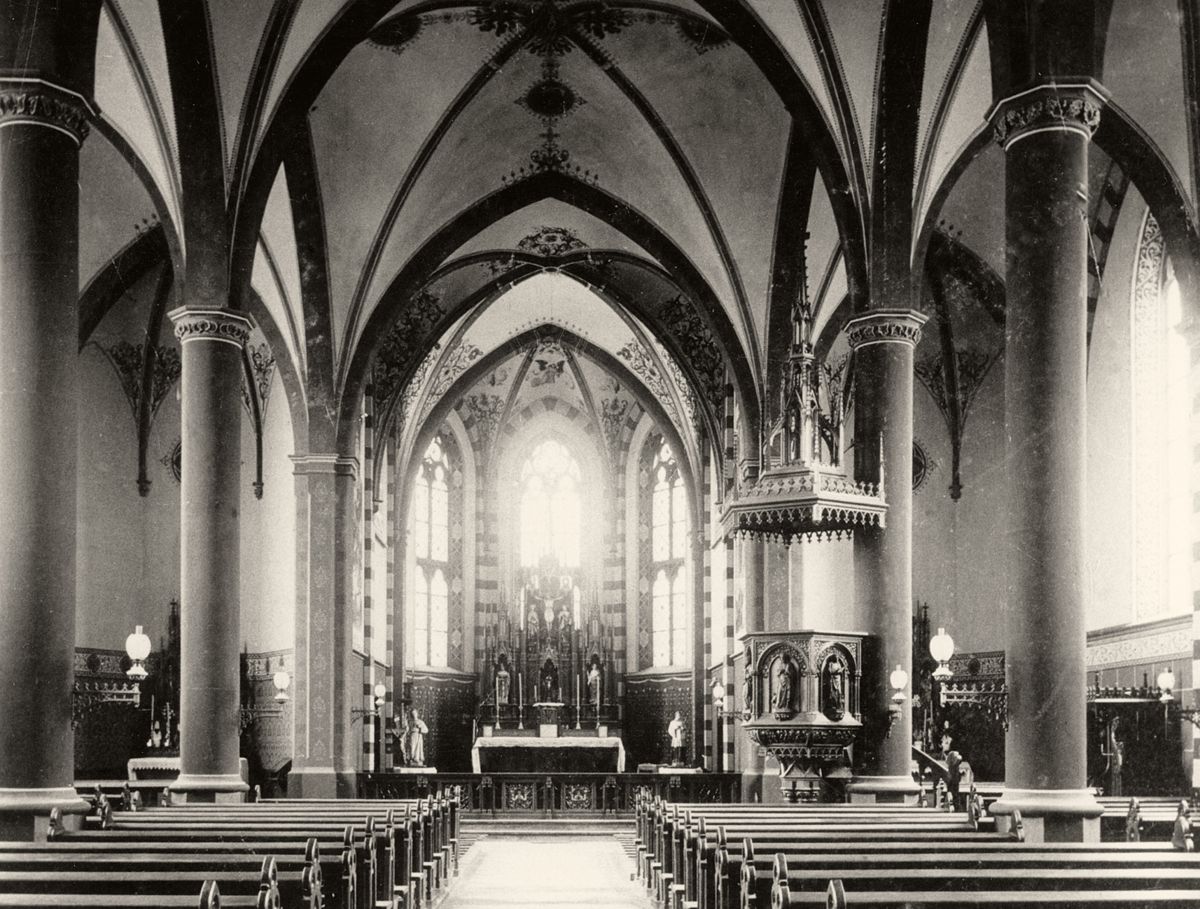
    The interior of the parish church of St. Servatius, c. 1921.
    The interior of the parish church of St. Servatius, c. 1921. Archiv Andreas H. Giersberg
  15. 1886

    An end to smoke and stench

    In February 1886, after almost eighty years, alum production ends. Alum could by then be produced „aus anderm Material auf kaltem Wege lohnender“ (more profitably from other material by a cold process); in addition, the clay deposit was exhausted and the production method outdated.

    Vol. I · Chapter 6

    In 1841 extraction was moved to Schweinheim, and in 1845 processing to a new works at the foot of the hill near Godesberg. The fumes from the roasting heaps, over which sulphuric acid was poured, drifted as far as Bonn when the wind was from the south; from 1877 the spa town of Godesberg quarrelled with the works over smoke and stench. A chemical factory operated in the buildings until 1898; in 1890 the Brande heirs gave up the mining rights. At its peak around 1836 the works had employed about 200 people; in 1854, 39 men still worked at the Godesberg works.

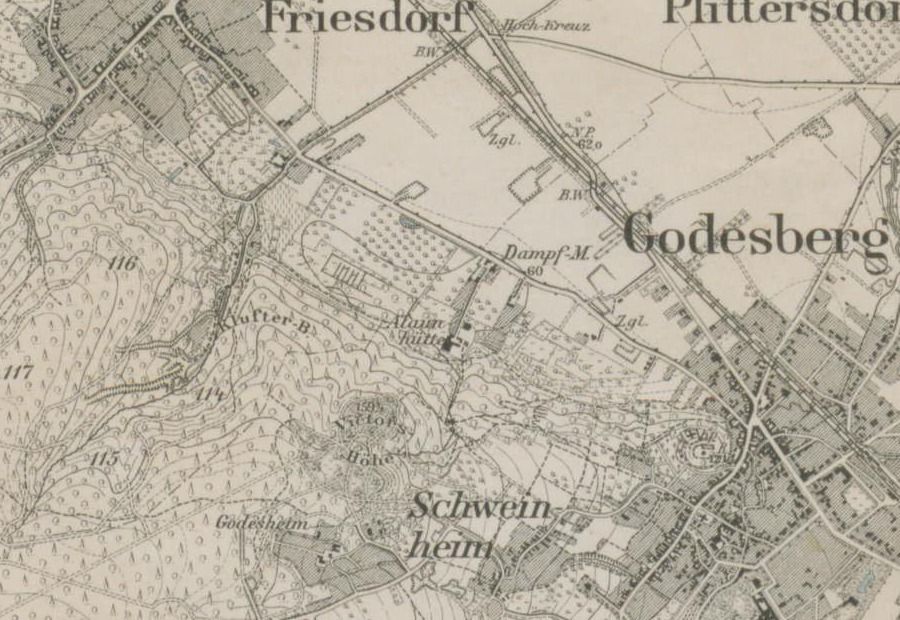
    The Godesberg „Alaun Hütte“ (alum works) on the Godesberg ordnance survey map, 1892–1899.
    The Godesberg „Alaun Hütte“ (alum works) on the Godesberg ordnance survey map, 1892–1899. Landesarchiv NRW, CC BY-SA 4.0
  16. 4 October 1898

    The last announced grape harvest

    The newspaper announces the harvest of the Frühburgunder grapes: „Die Quantität ist hier noch befriedigend, die Qualität gut.“ (The quantity here is still satisfactory, the quality good.) After that no harvest notice appears again.

    Vol. II · Chapter 17

    In the 1880s and 1890s the Bonn newspapers reported the Friesdorf grape harvest year after year; in 1884 the grapes fetched 20 pfennigs a pound. In 1901 only a few Morgen of vines were left at the Wolter brewery, and from 1907 no directory lists a Friesdorf winegrower any more. Today the street „Im Weingarten“ recalls viticulture.

  17. 1901

    The „Klösterchen“ opens its doors

    On 2 July 1901 the Paula-Maria-Stift nursery school is handed over to three Dernbach sisters. It was endowed by Eugen Pfeifer of the Annaberg estate; on the first day 110 children come.

    Vol. I · Chapter 6

    In many Friesdorf families all the adults had to work outside the village, but the municipality could not afford a nursery school. In 1899 the Cologne sugar manufacturer Pfeifer provided 10,000 marks and obtained the plot. The building, named after his wife, was the first in Friesdorf to have running water. The sisters looked after small children, gave girls needlework lessons and cared for the sick and the poor; locally the foundation was called the „Klösterchen“ (little convent).

  18. 1904

    Friesdorf becomes part of Godesberg

    On 30 June 1904 King Wilhelm II of Prussia approves the incorporation by royal decree. On 1 July 1904 Friesdorf's independence ends after more than a thousand years of documented history.

    Vol. I · Chapter 6

    Water supply, gas network and sewerage had overstretched the rural community: in 1902 its debts amounted to a good four times the annual budget, and the municipal tax stood at 160 per cent. On 1 December 1902 twelve citizens around the head of the community, Josef Peters, signed the application to Godesberg; a counter-petition campaigned for independence in 1903. The contract of 10 October 1903 regulated taxes and connection to the sewers. According to tradition, Peters received the decree at the entrance to the Klufterhof.

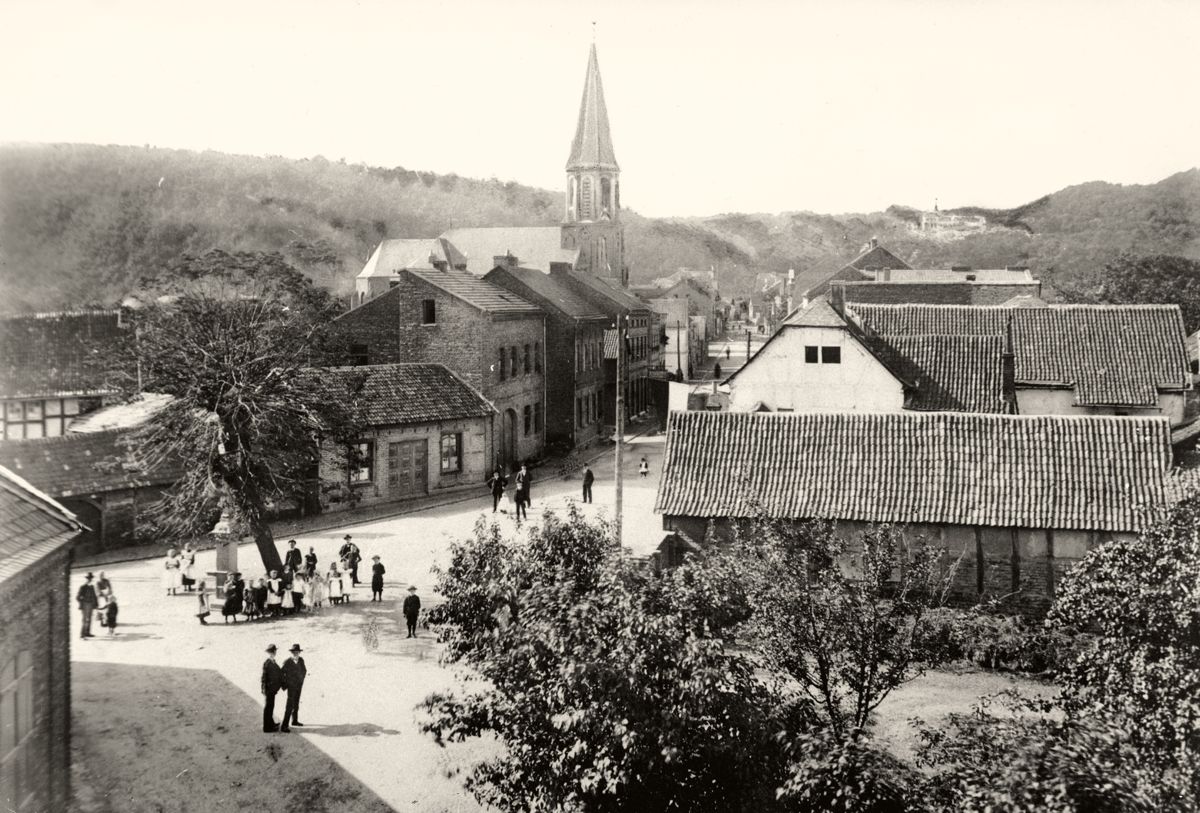
    The old Klufterplatz, c. 1904.
    The old Klufterplatz, c. 1904. Verlag Ferdinand Koll · Archiv Andreas H. Giersberg
  19. 20 March 1909

    Arndt Museum opened in the Arndtruhe

    In the Hotel-Restaurant „Arndtruhe“ on the Klufterbach a „historical Arndt room“ is inaugurated, suggested by the writer Joseph Lauff.

    Vol. II · Chapter 14

    The establishment had grown out of the forest tavern of the Wolter brewery. Joseph Loevenich, son-in-law of Mina Wallraff née Wolter, took it over between July 1902 and May 1903 and expanded it into a hotel restaurant. The name „Arndtruhe“ is attested as early as 1903, so it does not come from Lauff. The museum was founded by Loevenich and his wife Maria. In 1921 Loevenich sold his Arndt memorabilia to the city of Bonn.

Vol. I · Chapter 7 · 8 stations

World War & Weimar 1914–1933

Friesdorf in the First World War and the Weimar Republic

  1. 1914–1918

    A military hospital in the foundation, the fallen in the village

    In October 1914 the Paula-Maria-Stift takes in its first wounded as a military hospital. By the end of the war the school chronicle records a hundred Catholic and five Protestant fallen from Friesdorf.

    Vol. I · Chapter 7

    By the end of November 1914, 23 men from Friesdorf had already fallen. The founder, Eugen Pfeifer, provided 20 beds and bore the costs; in 1915, 157 soldiers were nursed there, and the foundation's kitchen served about 200 portions of soup a day. Schoolchildren dug over a municipal meadow for soldiers' wives and collected scrap metal, nettles and fruit stones. From November 1915 Tuesdays and Fridays were meatless days; in 1917 St. Servatius had to give up two bells and the organ pipes.

  2. 31 Oct. 1918

    Bombs on Bonn – a Friesdorf woman among the dead

    Shortly before the end of the war British bombers drop nine bombs over Bonn. The Friesdorf school chronicle counts 31 dead, among them Anna Riegel of Friesdorf.

    Vol. I · Chapter 7

    According to Hedrich-Winter, 30 people died; the city's chronological table gives 26.

  3. 1918/1919

    Canadians in school and dance halls

    After the end of the war Canadian infantry and a machine-gun unit are quartered in Friesdorf's school and dance halls. The inhabitants have to hand over surplus beds.

    Vol. I · Chapter 7

    The „machine-gun unit“ was the 1st Canadian Motor Machine Gun Brigade; according to its war diary it was in Friesdorf from 14 December 1918 to 4 February 1919. On 31 December it had itself photographed in front of the garden façade of Annaberg Castle. On 3 February 1919 the soldiers travelled from Mehlem station to Belgium, followed by the vehicles on 4 February. Then came an English battery; it left again in June, only its staff remaining at Annaberg Castle. Lessons were cancelled until 12 January 1919. From February 1920 French troops replaced the British in Bonn. The last prisoner of war from Friesdorf, Heinrich Peters of the Klufterhof, returned home from Orenburg in Russia on 14 July 1920.

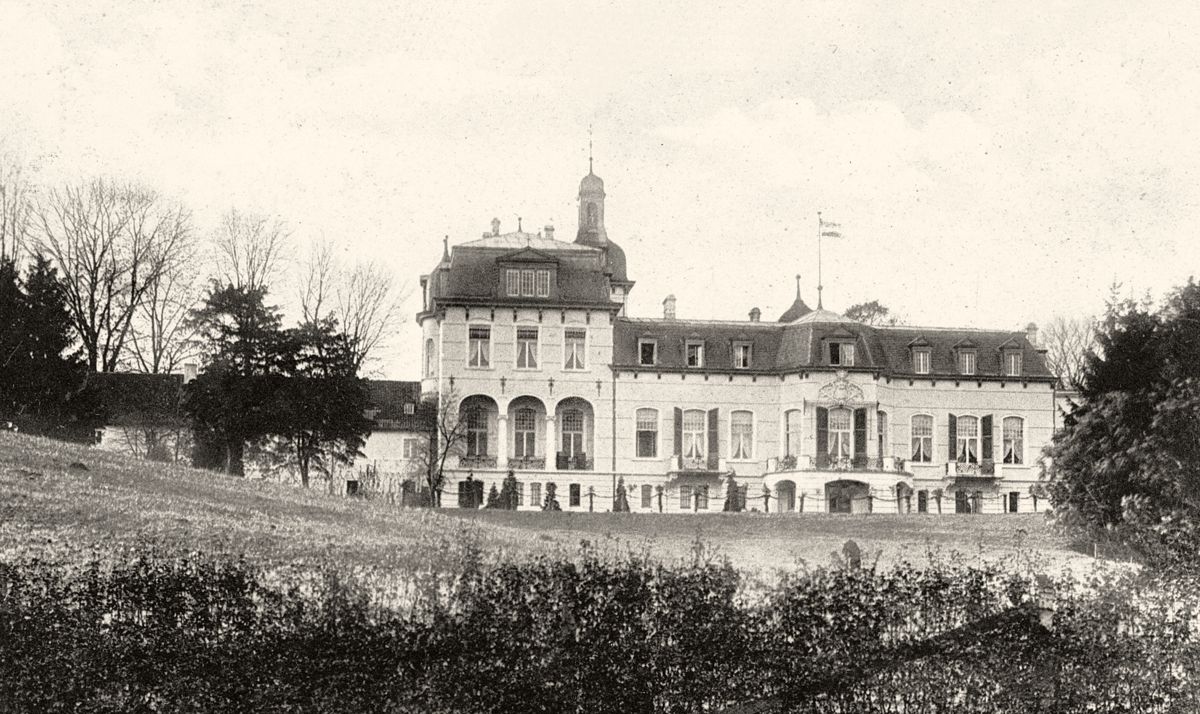
    Annaberg Castle, c. 1910.
    Annaberg Castle, c. 1910. Photogravure Koll-Verlag · Archiv Andreas H. Giersberg
  4. 5/6 June 1921

    A bell bazaar pays for three new bells

    After two bells had to be given up for armaments in 1917, a bell bazaar of the parish brings in a net profit of 145,000 marks.

    Vol. II · Chapter 16

    Parish priest Heinrich Rembold, in Friesdorf since October 1919, organised the bazaar together with the clubs. The proceeds were enough for three new bells from Hemelingen, electric light, a large wrought-iron chandelier and new organ pipes. In 1920 Rembold had also acquired the inn „Zum Hähnchen“ in the Bachele as a Catholic club house and had a war memorial set up under the church tower.

    Bell bazaar in Friesdorf, 1921.
    Bell bazaar in Friesdorf, 1921. Photo: Josef Düren · Archiv Andreas H. Giersberg
  5. 1923

    Expelled: Friesdorf railwaymen in the Ruhr struggle

    In March 1923, after an attack on the railway, the French arrest 30 railwaymen, more than 20 of them from Friesdorf. On 14 April they are expelled with their families.

    Vol. I · Chapter 7

    The expelled men went to Bad Salzuflen. After an attempted bombing of the Godesberg railway embankment, the military government twice imposed a week-long curfew from 7 p.m. to 6 a.m. At the same time inflation ate up wages: a bread roll cost 60,000 marks in Friesdorf, a single briquette later 1.5 million. Quakers from the USA made school meals possible for 50 children, and on 1 August 1923 the „Sterbenotgemeinschaft Friesdorf“ (Friesdorf funeral aid society) was founded.

  6. 1926

    Church bells for the end of the occupation

    In the night of 30/31 January 1926 all the church bells in Friesdorf ring between midnight and 1 a.m.: the occupying troops are leaving, and there is no school on Monday.

    Vol. I · Chapter 7

    Following the Locarno treaties, the Cologne zone, to which Bonn and Godesberg belonged, was evacuated from 30 November 1925; the last troops left at the end of January 1926. A few months later, by decree of 10 June 1926, Godesberg received permission to bear the name „Bad Godesberg“; it was only raised to the status of a town in 1935. For Friesdorf, the northern district, the title at first changed little.

  7. 1929

    One roof for all Friesdorf clubs

    On 11 March 1929 the Ortsausschuss Friesdorf (local committee) is constituted as the „representative body of all local clubs“. Georg Bauerfeind becomes its first chairman.

    Vol. I · Chapter 7

    It had been preceded in 1922 by a festival association of several clubs and in 1928 by the carnival committee „Kleffbotze“. The Ortsausschuss included choral societies, the church choir, marksmen, gymnasts, footballers – and the goat breeders' association, with 180 families the second-largest club in the village. It took over tasks that the municipal council used to have: the Kirmes, village festivals, common concerns. The first negotiations were dominated by a bus that only went as far as Dottendorf. On 3 February 1937 the NSDAP dissolved the Ortsausschuss.

  8. 1932

    A Centre Party stronghold: Friesdorf votes against the trend

    In the Reichstag election of 31 July 1932 the NSDAP receives only 11.0 per cent in Friesdorf – nationwide it becomes the strongest party with 37.3 per cent.

    Vol. I · Chapter 7

    In Friesdorf the Centre Party won 43.6 per cent, the SPD 21.7 and the KPD 18.6 per cent. In November 1932 the NSDAP fell to 8.7 per cent in the village, and even on 5 March 1933 it reached only 19.0 per cent. The chairman of the Godesberg Centre Party was the teacher Joseph Roth, married since 1924 to a woman from Friesdorf. On 13 March 1933 an SA detachment forced his suspension.

Vol. I · Chapter 8 · 28 stations

Nazi era 1933–1945

Friesdorf in the Nazi era

The timeline shows the twelve years of the Nazi era in more detail than the other epochs. Move the mouse over a station – or tap it – to read the details. People are named as the book names them.

  1. 5/12 March 1933

    Last elections: Friesdorf remains a Centre Party village

    In the Reichstag election of 5 March 1933 the Centre Party won undisputed in Friesdorf with 41.7 per cent; the NSDAP came second with 19.0 per cent.

    Vol. I · Chapter 8

    As late as July 1932 the NSDAP in Friesdorf was only in 4th place with 254 votes (11.0 per cent), behind the Centre Party, SPD and KPD; in November 1932 it fell to 8.7 per cent. After the Reichstag fire the Communists lost a good 40 votes on 5 March 1933, and the NSDAP won 470 votes. In the municipal council elections of 12 March 1933 the distribution was: Centre Party 47.7, NSDAP 19.6, SPD 18.6, KPD 9.2 per cent. The KPD, which had wanted to enter the municipal parliament with Franz Pick of Friesdorf, came away empty-handed: the Communist votes „fielen unter den Tisch“ (were swept under the table), and for many KPD members „Schutzhaft“ („protective custody“) began.

  2. 13/14 March 1933

    The SA occupies the town hall, Alef takes over

    On 13 March 1933 an SA squad occupied the Godesberg town hall and forced the „suspension“ of Mayor Zander. The following day Heinrich Alef, as state commissioner, in effect took over the office of mayor.

    Vol. I · Chapter 8

    An SA detachment of 20 to 30 men also appeared at the Burgschule and forced the suspension of the teacher Joseph Roth, chairman of the Godesberg Centre Party. On 14 March the General-Anzeiger reported the names: Mayor Zander, the deputies Fritzen and Voosen, office manager Berresheim, engineer Koll, administrative director Gummersbach and teacher Roth. Koll and municipal representatives of the SPD and KPD were taken into „protective custody“. Alef, an NSDAP member since 1930, was formally elected mayor on 21 April 1933 – in the absence of the SPD and KPD representatives. In 1956 the Higher Administrative Court in Münster found that he had become mayor „weil er Nationalsozialist war“ (because he was a National Socialist).

  3. 13 March 1933

    SPD workers taken away from the Godesia works

    On the same day, 13 March 1933, „Nazi officials“ took the metalworkers organised in the Social Democratic movement out of the Godesia works on Friesdorfer Straße, among them three men from Friesdorf.

    Vol. I · Chapter 8

    Foreman Werner Wichterich stood up for his men: if they were not wanted in their work clothes, they would stay here. The Friesdorf men Caspar Emsbach, Toni Mentis and Johann Huth were taken away – first to the Hesseler printing works, then to the jail on the market square. At the „Ännchen“ inn, Communists who had changed sides applauded. In the evening the three were released, but remained under surveillance for the duration of Nazi rule. Every Thursday they met at the Huth home, as long as the war allowed – the only documented Friesdorf SPD circle of friends. An informer once checked whether a picture of Hitler was still hanging on the wall.

  4. April–July 1933

    The Ortsausschuss and the village square „Am Waasem“

    On 4 April 1933 the Ortsausschuss of the nineteen Friesdorf clubs declared it a „heilige Pflicht“ (sacred duty) to place themselves at the service of the new era. At the same time the new village square was created.

    Vol. I · Chapter 8

    Chairman Georg Bauerfeind made the declaration in the presence of parish priest Dünner and head teacher Weißenfels. With the village square by the Huth inn, the club world went its own way: with the approval of Mayor Alef, 13 members of the Catholic Workers' Association moved the cross in front of the Wahlen inn to the square between 24 May and 1 June 1933. The document in the base names Pope Pius XI, Hindenburg and parish priest Dünner, but not Hitler. The square soon served as an assembly point for propaganda events; by October 1935 at the latest it was called „Schlageterplatz“ (attested until 1944). After the end of the war it was called „Am Waasem“ again.

  5. 1933

    Professor Hans Karl Rosenberg barred from his profession

    In 1933 the Friesdorf professor Hans Karl Rosenberg, a „half-Jew“ in Nazi terminology and politically active in the Centre Party, lost his post at the Bonn Pädagogische Akademie (teacher training college).

    Vol. I · Chapter 8

    Rosenberg lived at Hochkreuzallee 165 and before 1933 was known as a public critic of the Nazis; in 1932 he gave the main speech at the 25th anniversary of the Friesdorf KAB (Catholic Workers' Movement). After his forced suspension (according to Moll in spring 1933) he was demoted and retired. Under a pseudonym he wrote for the church newspaper. From 1935 he was a member of the parish council of St. Servatius; from November 1938 he no longer appeared there. In 1939 the family moved to Bad Godesberg, and he died on 17 April 1942. His recurring sentence: „Was muß man noch alles tun, um ein guter Deutscher zu sein?“ (What else does one have to do to be a good German?)

  6. July 1933

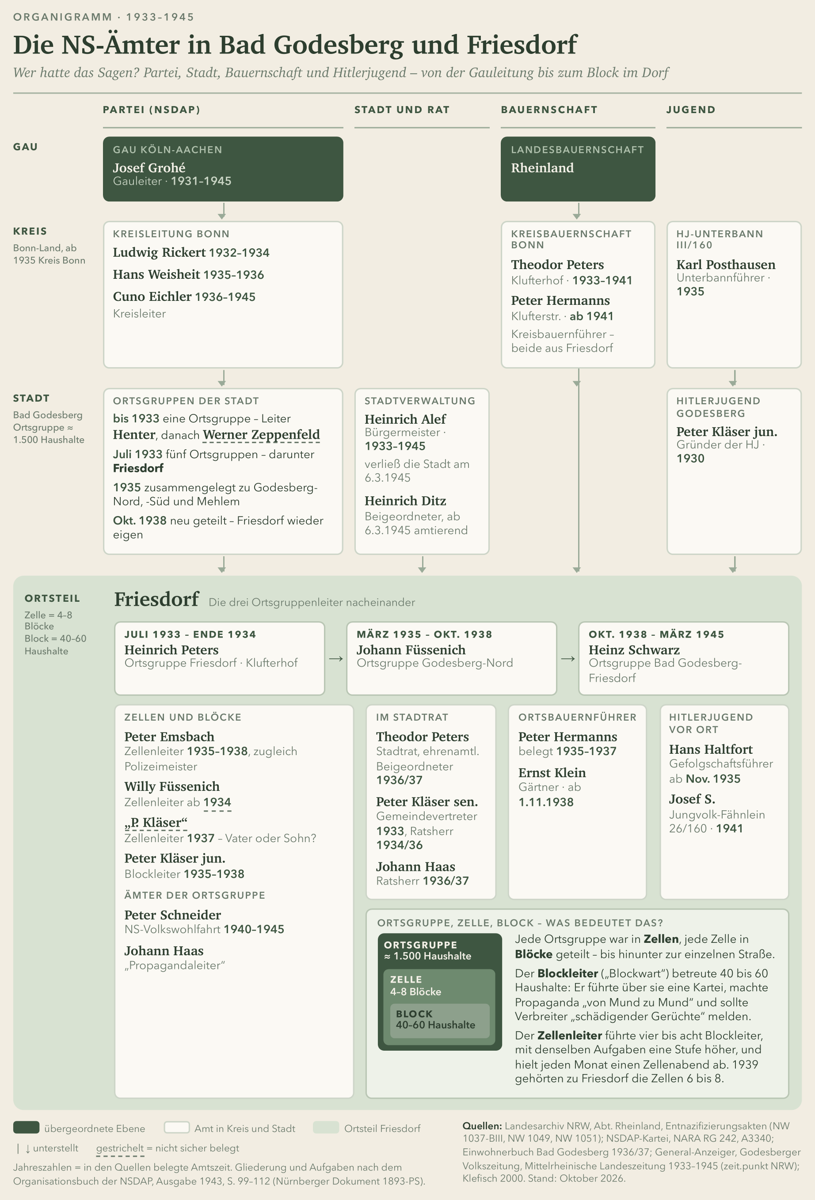
    Heinrich Peters becomes local group leader for Friesdorf

    In July 1933 Heinrich Peters, landowner of the Klufterhof, was announced as leader of the newly formed NSDAP local group in Friesdorf.

    Vol. I · Chapter 8

    Peters, formerly a captain in the merchant navy, had been a party member since 1 November 1929. His brother Theodor Peters of the Klufterhof was district farmers' leader from October 1933 to March 1941, chairman of the veterans' association and a town councillor in 1936/37. Peter Kläser sen., a farm labourer at the Klufterhof, sat on the municipal council for the NSDAP from 1933. The local group was divided into cells and blocks; a block comprised 40 to 60 households, often just a few houses on one street. The block leader kept a card index of „his“ households and was supposed to report anyone spreading „harmful rumours“. At the end of 1934 Peters became mayor of the Villip district.

    The Nazi offices in Bad Godesberg and Friesdorf 1933–1945.
    The Nazi offices in Bad Godesberg and Friesdorf 1933–1945. Graphic: Friesdorf-Verlag 2026
  7. June–Oct. 1933

    Gleichschaltung of the Friesdorf clubs

    Between June and October 1933 the Friesdorf clubs came under pressure: youth clubs were temporarily dissolved, and boards were filled anew according to the „Führerprinzip“ (leader principle).

    Vol. I · Chapter 8

    On 5 July 1933 the General-Anzeiger reported that the Catholic youth and young men's associations of Godesberg, Friesdorf, Plittersdorf and Mehlem had been dissolved and their club houses closed; at first the ban did not last. In June 1933 the board of the Ballspielverein 09 (ball games club) resigned in accordance with the guidelines of the Reich Sports Commissioner. On 15 October 1933 the Sterbenotgemeinschaft Friesdorf with its 880 members was brought into line; district farmers' leader Theodor Peters spoke on behalf of the local group leadership. From May 1933 the German Labour Front maintained a local cell in Friesdorf. The DJK Concordia Friesdorf (Catholic sports club) was banned and dissolved in 1935.

  8. 14 Sept. and 5 Oct. 1933

    Stones thrown at the parish house of St. Servatius

    In two night-time attacks the parish house of parish priest Wilhelm Dünner was attacked; in the second, around 80 half-bricks were hurled at the windows.

    Vol. I · Chapter 8

    The occasion was the transfer of chaplain Hubert Scheidt, who according to a statement by Alef had already been an NSDAP member for two years. On 14 September 1933 a chanting crowd demanded Dünner's departure; Mayor Alef asked him to spend the night elsewhere because he could not guarantee his safety. On 5 October stones also smashed the Sacred Heart picture at the entrance. On 8 October Dünner said at Mass that he could „nicht mehr schweigen“ (no longer remain silent); the five Catholic associations demanded that Alef prosecute the perpetrators. Because his life seemed to be in danger, Dünner lived in Cologne until 8 January 1934. According to Schwalb he waived prosecution in his will; after the war there was never an indictment.

  9. 12 Nov. 1933

    100 no votes in Friesdorf II

    In the plebiscite of 12 November 1933, 100 of 1,455 voters in the Friesdorf II polling district vote no – after Lannesdorf the second-highest share of no votes in the Godesberg district; in Friesdorf I there are 17.

    Vol. I · Chapter 8

  10. Jan.–March 1934

    Hitler Youth against Catholic youth

    Between 14 January and 3 March 1934 the Godesberg parish youth leader Aloys Seul counted ten attacks by the Hitler Youth on the Catholic youth; after that it was forbidden any public activity.

    Vol. I · Chapter 8

    The attacks ranged from tearing off the cross on the lapel to beating up individual boys after club evenings, mainly at the Klufterhof. Toni Goi of Friesdorf was offered a job at the post office only if he took off „the blue shirt“ and put on „the brown one“; he declined. As early as the feast of Christ the King in 1933 or 1934 a Hitler Youth troop had attacked the Friesdorf Sturmschar, the „Turmhausfalken“ (tower house falcons); they were able to collect their banner from the mayor's office the next morning. None of the hard core of 15 Friesdorf Sturmschar members went over to the Hitler Youth. From then on the Catholic youth of the area met in secret, for instance at Drachenburg Castle or at the Aloisius-Kolleg.

  11. 22 May 1934

    Head teacher Weißenfels is demoted to teacher

    On 22 May 1934 the Prussian Minister of Education, on the basis of the Civil Service Law, transferred the Friesdorf head teacher Joseph Weißenfels to the post of an ordinary elementary school teacher.

    Vol. I · Chapter 8

    The demotion took effect on 1 May 1935: Weißenfels had to continue working as an ordinary teacher at the school he had previously headed. He was a member of the Centre Party, left the renamed „Stahlhelm“, worked together with the local clergy and kept his three children away from positions in the Hitler Youth and the League of German Girls. He did not belong to the NSDAP. The picture has its breaks: at the St. Martin's festival in 1933 he spoke of the „vom Führer Adolf Hitler erstrebten Volksgemeinschaft“ (national community striven for by the Führer Adolf Hitler). Head teacher Heinrich Schieffer of the Burgschule was also demoted in 1934. In 1945 Weißenfels became school inspector of the Cologne-Land district.

  12. 9 May 1936

    High treason trial against Friesdorf Communists

    On 9 May 1936 the 5th Criminal Senate of the Higher Regional Court of Hamm, sitting in Bonn, convicted 71 of 74 defendants, among them Friesdorf Communists around Matthias Kraus and Ferdinand Latz.

    Vol. I · Chapter 8

    The Friesdorf KPD rank and file had re-formed underground. Drivers from the Cologne Auermühle brought newspapers along with the flour for the bakers to Matthias Kraus's workplace; Ferdi Latz distributed them in Godesberg. After the arrest of a Cologne courier in June 1935 some 150 arrests followed in the Bonn area. Kraus received four years' penal servitude, Latz six, Franz Rehfeld two and a half, and Servatius Güssgen, born in Friesdorf, one and a half years. Franz Pick spent six months in protective custody in 1935. According to Schwalb, Kraus was sent to Penal Battalion 999 in 1943 and has been missing since his last letter from the island of Kos.

  13. 3 Feb. 1937

    The Friesdorf Ortsausschuss is dissolved

    On 3 February 1937 cell leader P. Kläser, on behalf of local group leader Johann Füssenich, dissolved the Friesdorf Ortsausschuss, the umbrella association of the local clubs.

    Vol. I · Chapter 8

    At the beginning of 1935 the local groups of Plittersdorf and Friesdorf had been merged into the Godesberg-Nord local group; at the ceremony in the Ännchen hall, reported by the General-Anzeiger on 11 March 1935, Heinrich Peters said farewell to his local group. Johann Füssenich, an NSDAP member since 1932, became its leader. Until 1938 Friesdorf had no local group of its own. In December 1933 the Ortsausschuss had still organised the clubs' joint „German Christmas“, suggested by district farmers' leader Theodor Peters. Whether „cell leader P. Kläser“ was Peter Kläser sen. or his son of the same name cannot be decided.

  14. Feb. 1938

    The Gestapo dissolves the young men's association

    In February 1938 the Gestapo dissolved the Catholic young men's association of Friesdorf and confiscated the consecrated church banner, furniture and the cash box containing 3.13 marks.

    Vol. I · Chapter 8

    The association had only a few members left. As early as 4 June 1936 the school chronicle had noted that all boys and girls over ten were „in der Hitlerjugend“ (in the Hitler Youth). In August 1938 the army garrison administration requisitioned the hall of the Catholic club house; the school thereby lost its gymnasium. On 18 April 1939 the chronicle noted: „Statt der kath. Volksschule gibt es nur noch die deutsche Schule.“ (Instead of the Catholic elementary school there is now only the German school.) The Catholic elementary school had thus become a state „German school“.

  15. Oct. 1938

    A separate local group Bad Godesberg-Friesdorf under Schwarz

    When the Godesberg local groups were reorganised in October 1938, Friesdorf again received its own NSDAP local group; its leader was the municipal cashier Heinrich Josef „Heinz“ Schwarz.

    Vol. I · Chapter 8

    In the memories of contemporary witnesses he appears as „Franz Schwarz“. In 1939 the local group was responsible for cells 6 to 8; in 1939 its office was at Bonner Straße 43. In February 1939 the three cells held a joint cell evening at the Franz Heubach inn on Annaberger Straße. Schwarz is securely attested for Friesdorf until July 1942, and in September 1944 he was serving as local group leader. According to Schwalb, during the war he had to deliver the news of the „Heldentod des Sohnes oder Vaters“ (hero's death of a son or father) to more than 100 Friesdorf families. The local group's National Socialist People's Welfare was headed from 1940 to March 1945 by municipal secretary Peter Schneider.

  16. Nov. 1938

    Jewish families: persecution, arrest, flight

    During the November pogrom of 1938 the physician Dr. Arthur Samuel was arrested; he and his family had only moved to Friesdorf on 5 October 1938.

    Vol. I · Chapter 8

    Samuel, for ten years chairman of the Bonn synagogue community, had been forced to give up his Bonn practice and sell his house in 1938. As chairman he was released because he was to continue handling the community's affairs. A few months later, after he had been arrested again, the family managed to flee via the Netherlands to the USA. The master butcher Otto Jülich, born in Friesdorf, had already emigrated to the USA in January 1938, after boycotts and bans on supplies had forced him to close his business. The Jewish physician Dr. Weck of Annaberger Straße 169 had to leave Friesdorf after being barred from practising.

  17. July 1940

    Prisoners of war and forced labourers in the village

    In July 1940 the local farmers' association rented the hall of the Catholic club house for 30 Polish prisoners of war. From then on foreign workers laboured on Friesdorf's farms and in its businesses.

    Vol. I · Chapter 8

    According to the lists of the rural health insurance fund, they also worked for the Nazi functionaries themselves: four for district farmers' leader Theodor Peters at the Klufterhof, three for Peter Hermanns, two for local farmers' leader Ernst Klein. In February 1941 Peters warned „die Polen nicht wie Familienangehörige zu behandeln“ (not to treat the Poles like members of the family). On the site of the Godesia works there was a camp for about 30 Italian prisoners of war. The Polish farm labourer Jan Deplewski, In der Kumme 1, was held by the Gestapo in 1941 and 1943; finally he was arrested „wegen Arbeitswiderwilligkeit und tätl. Angriffs gegen den Bauer“ (for unwillingness to work and physical assault on the farmer) and sent to a labour education camp. He survived.

  18. Night of 5/6 April 1942

    First heavy bombs: damage at the Arndtruhe

    In the night of 5/6 April 1942 three high-explosive bombs, among them a parachute mine, fell on Friesdorf. Several houses at the Arndtruhe were badly damaged, and 80 people were made homeless.

    Vol. I · Chapter 8

    According to the school chronicle, 20 shop windows were broken and many roofs were stripped; no one was killed. 80 homeless people corresponded to about two per cent of the population. As early as the night of 5/6 August 1941 the air-raid protection service for Godesberg-Friesdorf had reported three high-explosive bombs and some incendiary bombs causing great damage to property at a factory; in autumn 1941, according to the school chronicle, the first bombs fell „ohne großen Schaden zu hinterlassen“ (without leaving great damage). In winter 1942 the school had to save coke: ten classes were taught in six rooms, and from 16 February to 3 March there were coal holidays.

  19. 15 June 1942

    Deportation of Ella Maria Michaelis and Henriette Heumann

    On 15 June 1942 Ella Maria Michaelis from the Kumme was deported to the Sobibor extermination camp; on the same day Henriette Heumann, born in Friesdorf, was deported from Cologne to Theresienstadt.

    Vol. I · Chapter 8

    No date of death has been handed down for Ella Maria Michaelis, born in Cologne in 1880; a Stolperstein (memorial stone) in front of the house at In der Kumme 119 commemorates her. Henriette Heumann, born in Friesdorf in 1861 and last resident in Bonn and Beuel, died in Theresienstadt on 5 July 1942. Carolina Wolkenaer née Leib, born in Friesdorf, was deported from Cologne on 28 October 1943 and died in Theresienstadt on 23 January 1944. According to Schwalb, a „Jüdin Frau Fischer von der Annaberger Straße 47“ (Jewish woman, Mrs Fischer of Annaberger Straße 47) took her own life before she was to be deported from Bonn, probably in 1941 or 1942.

  20. Night of 16/17 April 1943

    Parachute mine on the Klufterstraße: 26 dead

    In the night of 16/17 April 1943 a single RAF aircraft dropped a parachute mine on the Klufterstraße. 26 people died, among them four pupils of the Friesdorf elementary school.

    Vol. I · Chapter 8

    During Operation „Frothblower“ against the Škoda works in Pilsen, the Lancaster W4783 „G-George“ failed to find its target and on the return flight attacked an alternative target that the crew believed to be Koblenz – according to the log, „vermutlich über Koblenz“ (probably over Koblenz). The 1.8-tonne mine was not dropped on Friesdorf deliberately. The Fandel, Wiesel, Krieger and Poppelreuter families were especially hard hit; among other things the mine destroyed the building of the Nothbaum inn. The fire brigade was deployed with 77 helpers, and Matthias Kraus helped to rescue the wounded. In the city's obituary, Mayor Alef declared that the dead had died „im Kampf für Deutschlands Freiheit“ (in the struggle for Germany's freedom).

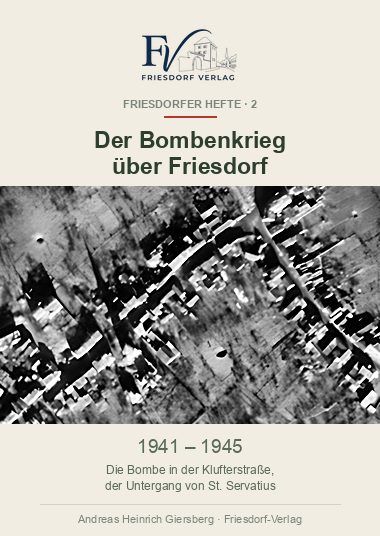
    Cover picture of the booklet „Der Bombenkrieg über Friesdorf 1941–1945“ (The bombing war over Friesdorf).
    Cover picture of the booklet „Der Bombenkrieg über Friesdorf 1941–1945“ (The bombing war over Friesdorf). Friesdorf-Verlag
  21. 1943/44

    Air-raid protection: tunnels, beer cellars and slit trenches

    After the attack on the Klufterstraße the people of Friesdorf reinforced their cellars in 1943, drove tunnels into the hill and fitted out former beer cellars as air-raid shelters.

    Vol. I · Chapter 8

    According to the school chronicle, a former beer cellar at the Arndtruhe was fitted out as an air-raid tunnel, as was one in the upper village; the brewery's rock cellar in the Klufterbach valley also served the surrounding residents as an air-raid bunker during the war. In the school yard and on the Schlageterplatz three-metre-deep slit trenches with concrete roofs were built; the trenches on the Schlageterplatz were completed in 1944 by Dutch foreign workers. Because of the daytime raids the children often had to spend hours in the air-raid cellar. In autumn 1944 lessons were not resumed: the air raids no longer allowed „einen geordneten Unterricht“ (orderly teaching).

  22. 5 Dec. 1943

    Death of the institutional patient Hubert Stoßdorf

    On 5 December 1943 the seventeen-year-old Hubert Stoßdorf of Friesdorf died in the Alexian institution in Mönchengladbach – as an institutional patient at the time of the Nazi murders of the sick.

    Vol. I · Chapter 8

    Hubert Stoßdorf, born in Friesdorf in 1926, suffered from tuberous sclerosis with epileptic seizures. From 1938 he lived in the Franz-Sales-Haus in Essen, from which hundreds of residents were transferred in these years and many killed, and from August 1942 in Mönchengladbach. The causes of death given „nach offiziellen Angaben“ (according to official information) were tuberous sclerosis, epileptic seizures and peritonitis. Whether his death was brought about cannot be established without his medical file. He was not a victim of „Aktion T4“; he is one of the victims of the Nazi persecution of sick and disabled people. Since 2023 a Stolperstein at Frankengraben 40 has commemorated him.

  23. 22 Aug. 1944

    „Aktion Gitter“: arrests in Friesdorf

    On 22 August 1944, in „Aktion Gitter“, the Gestapo also arrested former office holders and functionaries in Friesdorf, among them the teacher and former Centre Party chairman Joseph Roth.

    Vol. I · Chapter 8

    Along with Roth, the KAB chairman Johann Schwalb and the former SPD member Caspar Emsbach were arrested; Schwalb was released after three days because of a kidney disease. Josef Berg had warned Roth at midnight; fleeing could have meant the arrest of his family. According to Wilhelm Roth's account, local group leader Schwarz is said to have been involved in drawing up the list; a letter of 1948 names only a meeting with Alef in this connection. Schwarz denied the accusations, and several witnesses exonerated him. By way of the Bonn Gestapo house and the Cologne exhibition grounds, Roth arrived in Buchenwald on 16 September 1944 (prisoner number 81555). His twelve-year-old son Wilhelm was locked up and interrogated in Cologne.

  24. 21 Dec. 1944

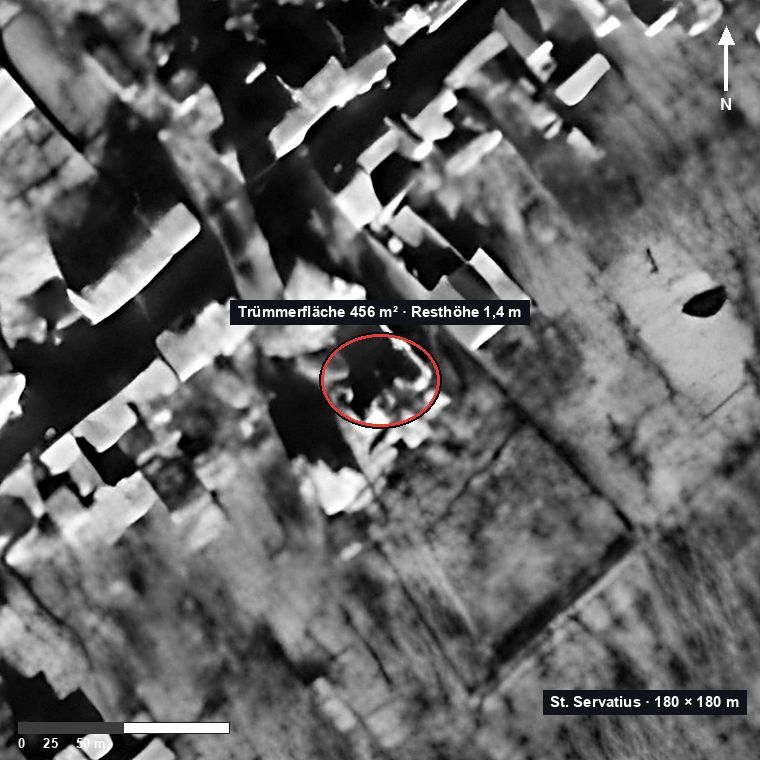
    Bombs destroy the parish church of St. Servatius

    On the evening of 21 December 1944 the parish church of St. Servatius was destroyed; only the tower remained standing. The sexton, organist and choirmaster Johannes Schmitt died in the ruins.

    Vol. I · Chapter 8

    Schmitt was in the church preparing for Christmas. On the evening of that day the Royal Air Force attacked the railway installations in Bonn with 97 Lancaster bombers and 17 Mosquitos; because of the solid cloud cover the bombs fell without aim. Judging by the date and time of day, the destruction of the church very probably goes back to this raid. The same raid badly damaged the tower house and the building of the Stuch inn. The parish at first held its services in the house chapel of the Paula-Maria-Stift, then in an emergency church in the dance hall of the Jakob Huth inn. The rebuilt church was blessed on 22 December 1950.

    The destroyed parish church of St. Servatius in an Allied reconnaissance aerial photograph of 13 February 1945 (detail).
    The destroyed parish church of St. Servatius in an Allied reconnaissance aerial photograph of 13 February 1945 (detail). Allied aerial photograph · analysis Friesdorf-Verlag
  25. 22 Jan. 1945

    Death of Joseph Roth after his imprisonment in a concentration camp

    On 22 January 1945 Joseph Roth died in Friesdorf, barely three months after his release from Buchenwald concentration camp. He was 48 years old.

    Vol. I · Chapter 8

    According to family tradition, Roth had returned home at the end of October 1944 emaciated from 110 to 48 kilograms, „gebrochen an Leib und Seele“ (broken in body and soul). He had to give up his Volkssturm service after three days. On 27 January 1945 he was allowed to be buried in the Friesdorf cemetery only early in the morning and in complete silence; neighbours' children pulled the coffin on a double sledge. The death notice was not allowed to tell the truth: it spoke of a death „infolge seiner bei den letzten Fliegerangriffen stark erschütterten Gesundheit“ (as a result of his health, badly shaken by the recent air raids). Today the Joseph-Roth-Straße, a grave of honour and two Stolpersteine commemorate him.

  26. 4 Feb. 1945

    Bombs destroy the Hotel Arndtruhe

    On 4 February 1945 aerial bombs destroy the Hotel-Restaurant Arndtruhe on the Klufterbach; it is not rebuilt. On the same day incendiary bombs destroy the Catholic club house Im Bachele.

    Vol. II · Chapter 14

    Several houses at the Arndtruhe had already been badly damaged in the night of 5/6 April 1942. Today the residential street „An der Arndtruhe“ and the rock cellars recall the place.

  27. 6–8 March 1945

    Alef flees, Bad Godesberg is handed over without a fight

    Mayor Alef left the town on 6 March 1945. Early in the morning of 8 March American troops occupied Bad Godesberg without a fight.

    Vol. I · Chapter 8

    Alef told the office managers that it was „nicht Feigheit, sondern Selbsterhaltungstrieb“ (not cowardice but the instinct of self-preservation) and informally handed over the business to the deputy Heinrich Ditz. The handover came about with the participation of the battle commander Lieutenant General Richard Schimpf, Ditz and the Swiss consul v. Weiß; Schimpf surrendered to Lieutenant Colonel Frank L. Gunn. Nobody from the party was to be seen in those days. In Friesdorf on 8 March a German gun with six shells took up position on the Schlageterplatz; with three bottles of wine the population persuaded the gun crew to withdraw.

  28. 9 March 1945

    Americans in Friesdorf, Ditz becomes mayor

    According to the American combat reports, a company of the 7th Armored Division occupied Friesdorf without resistance on 9 March 1945. The Americans installed Heinrich Ditz as mayor.

    Vol. I · Chapter 8

    Company B of the 48th Armored Infantry Battalion advanced from Ippendorf, „met no opposition and took Friesdorf“. According to local tradition, American tanks were already standing near the Klufterhof on 8 March; probably the southern part of the village was reached on 8 March and the rest on 9 March. Ditz, already appointed on 8 March by the town commander Captain Carrier, had been mayor of the Bornheim district until 1933; the National Socialists had removed him in May 1933 and transferred him to Duisdorf, where he was dismissed again in 1934. On 31 March 1945 he was provisionally relieved of his office. The military government imposed a curfew. Typhus was rampant among the forced labourers. The deserter Fritz Sieger was able to move about freely again.

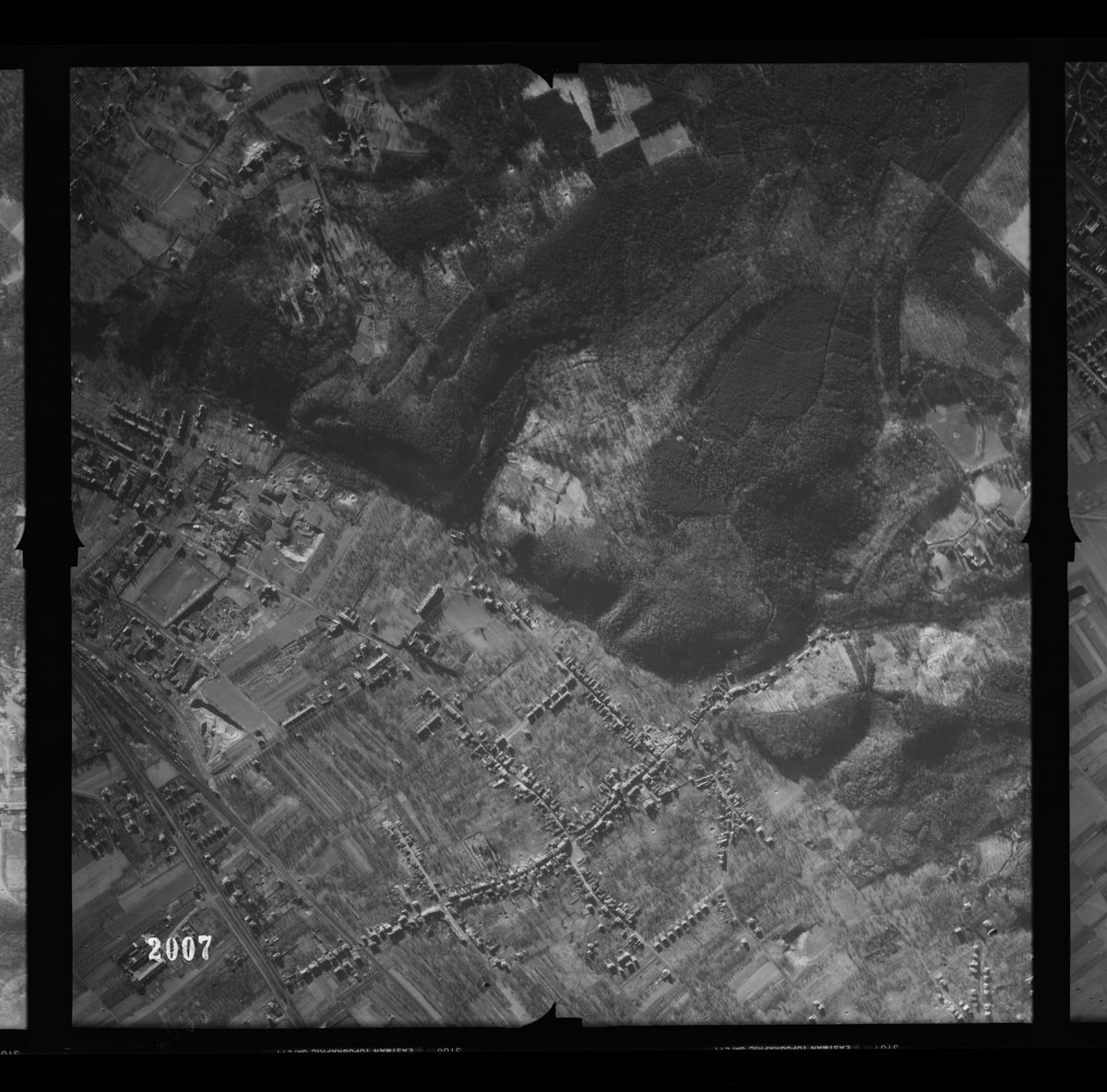
    Friesdorf in an aerial photograph of 1945.
    Friesdorf in an aerial photograph of 1945. Archiv A. Giersberg

Vol. I · Chapter 9 · 12 stations

Bonn Republic 1945–1999

Friesdorf in the post-war period and the Bonn Republic

  1. 1 May 1945

    An emergency church in the dance hall of the Huth inn

    The parish church lies in ruins; according to Berchem the parish leases the dance hall of the Jakob Huth inn at the Waasem as an emergency church from 1 May 1945 – according to the General-Anzeiger of 1949 it served as an emergency church „seit Oktober 1945“ (since October 1945).

    Vol. I · Chapter 9

    Before that, the house chapel of the Paula-Maria-Stift was used. The lease of 200 Reichsmarks a month was valid for ten years or until a new church was completed and excluded any restaurant business in the building. Parish priest Josef Kelzenberg led the parish through the first years of hardship. Because all the other halls in Friesdorf had also been destroyed, the town of Bad Godesberg had the hut „Margaretenhof“ put up on Margaretenstraße as a temporary solution in 1948/49.

  2. 1944/1948

    Bombs, moving out, rebuilding

    On 21 December 1944 bombs hit Friesdorf; the Turmhof is so badly damaged that the tenants have to move out. In 1948 it is rebuilt – with a pyramid roof.

    Vol. II · Chapter 12

    The 19th-century mansard roof had been destroyed. That the house was saved is thanks to the Landschaftsverband Rheinland (regional authority), the town of Bad Godesberg and the owner at the time; he pressed for reconstruction because three families could thereby get a home again. The office of the state conservator and the Friesdorf building firm Noisten und Walbröhl restored the building. Today the tower house is a private residence restored in keeping with its listed status and the main motif of the village coat of arms.

  3. 29 Feb. 1948

    The Ortsausschuss comes back to life

    Eleven years after its dissolution, a meeting of all the Friesdorf clubs decides to revive the Ortsausschuss; the former board is reinstated.

    Vol. I · Chapter 9

  4. 10 May 1949

    Bonn becomes provisional federal capital

    In the Pädagogische Akademie, less than 2 km from the Friesdorf boundary, the Parliamentary Council decides to make Bonn the provisional federal capital.

    Vol. I · Chapter 9

    Friesdorf lay in the „Bonn enclave“, where the Federal Government, the Bundestag, the federal ministries and the Allied High Commission took up residence. For the district, which had just under 4,000 inhabitants in 1948, this was noticeable within months: the country road between Bonn and Bad Godesberg, later the B 9, became the main axis between the Bundeshaus and the Petersberg. Locals called it the „Diplomaten-Rennbahn“ (diplomats' racetrack).

  5. February 1950

    The „French estate“ at the Klufterhof

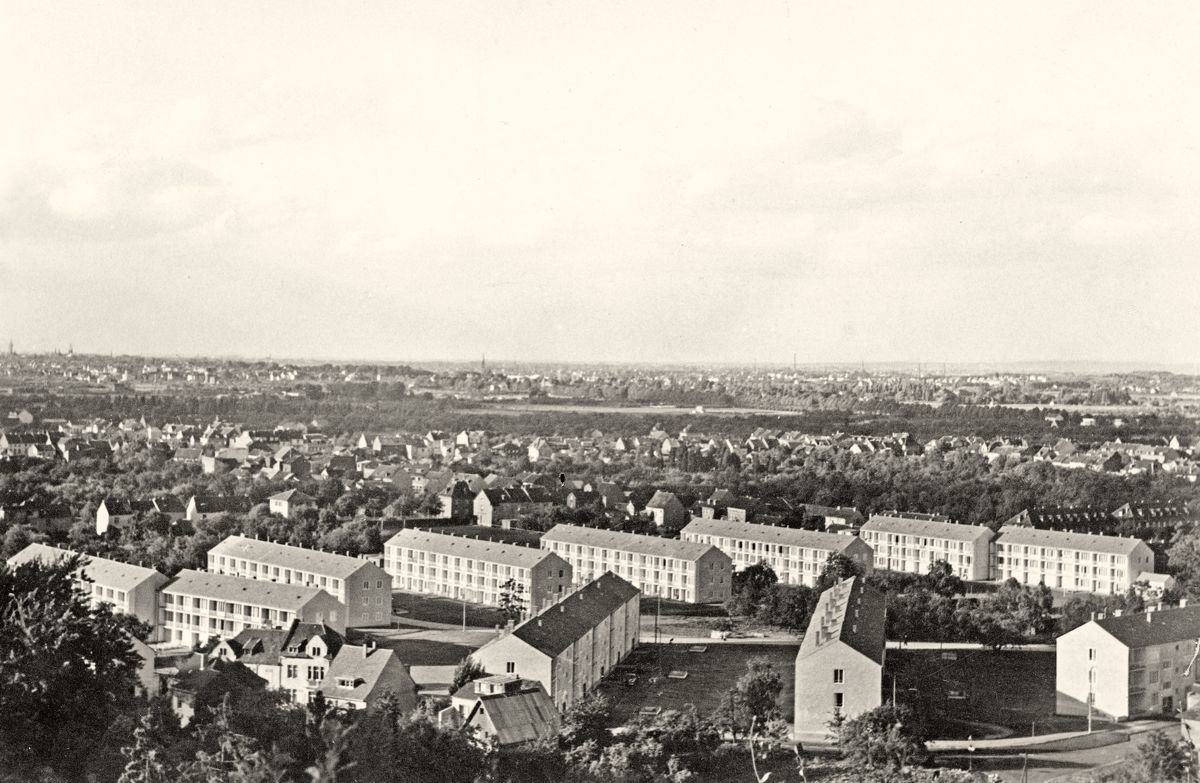
    In February 1950 construction begins on the Klufterhof estate, the first section of the „Housing Programme of the High Commission“; by the end of July 1950, 130 flats are completed.

    Vol. I · Chapter 9

    Building took place between Hochkreuzallee, Klufterstraße, In der Maar and In der Kumme. The shells stood after thirty days, and the topping-out ceremony was held on 27 April 1950. Because the Americans declined, the estate was allocated to members of the British and French occupying powers; in September 1950 the English children received a five-class school there. In Friesdorf it is called the „Französische Siedlung“ (French estate); when the French moved in, the Hotel Drachenfels in Mehlem became free.

    The »French estate« shortly after its completion in July 1950.
    The »French estate« shortly after its completion in July 1950. Archiv Andreas H. Giersberg
  6. 22 December 1950

    Rebuilt parish church of St. Servatius blessed

    Six years after its destruction, parish priest Josef Kelzenberg blesses the rebuilt parish church and in the evening celebrates the first High Mass.

    Vol. I · Chapter 9

    After the first sod was turned on 11 September 1949, cathedral canon Prelate Dr. Wilhelm Corsten laid the foundation stone on 30 October 1949; the plans were by the Cologne building officer Otto Bongartz. The new building followed the lines of the neo-Gothic hall church but was extended to the west, because the parish had grown greatly through the arrival of expellees. The Baroque statue of St. Servatius returned. The consecration was performed by Auxiliary Bishop Joseph Ferche on 16 November 1952.

  7. 1960

    Protestant Pauluskirche consecrated

    On the street In der Maar the Protestant Pauluskirche is consecrated, designed by the Krefeld architect Ernst Fohrer.

    Vol. II · Chapter 16

    Opposite stands the Maarhaus, built in 1937, the first Protestant meeting place in Friesdorf. After the war the congregation grew through expellees and federal civil servants moving in. The cubic brick building with a free-standing light-coloured tower received an organ from the Göttingen workshop of Paul Ott in 1966 and windows by Reimund Franke in 1985. In 2003 the Paulus congregation merged with the Christus congregation of Plittersdorf to form the Thomas congregation.

  8. 1961

    From the Waasem to the Klufterplatz

    The old Huth inn is demolished together with its hall; the village square at the Waasem receives fountains, trees and the name „Klufterplatz“.

    Vol. I · Chapter 9

    Since 1950 the square had been called „Joseph-Roth-Platz“. Many Friesdorf people did not take to the name; at the request of the Ortsausschuss the town council revoked it again in 1956. In place of the Huth inn a residential and commercial building was erected with the new Huth inn and the INFAS institute. The new name of the square recalls the Klufterhof and the Klufterstraße; one of the two fountains was named after the town councillor Wilhelm Windeck.

    The old Huth inn on 2 June 1961.
    The old Huth inn on 2 June 1961. Photo: Andreas Giersberg
  9. 1969–1975

    Kreuzbauten for the federal ministries

    On today's Heinemannstraße two cross-shaped high-rise buildings are built – the first new buildings in Bonn erected specifically for federal ministries.

    Vol. I · Chapter 9

    The master plan by the architect Joachim Schürmann provided for seven such „Kreuzbauten“ (cross buildings) for all the federal ministries; only two were built, to a design by Planungsgruppe Stieldorf, with fifteen and thirteen storeys. They retained their ministerial use even after 1999, today among others for the Federal Ministry of Research, Technology and Space. In 2004 the ensemble was listed as a monument.

  10. 1 August 1969

    Friesdorf becomes part of Bonn together with Bad Godesberg

    With the Bonn Act, the town of Bad Godesberg, to which Friesdorf has belonged since 1904, becomes a borough of the new independent city of Bonn.

    Vol. I · Chapter 9

    For Friesdorf it was the second incorporation in 65 years. 1 July had been planned, but the Constitutional Court of North Rhine-Westphalia had suspended implementation for a month. The cadastral district of Friesdorf still exists in the land register today. In November 1969 (according to another source on 29 October) the Friesdorf Spar- und Darlehnskassenverein merged with the Spar- und Kreditbank Mehlem to form the Bad Godesberger Kreditbank.

  11. 15 August 1981

    Indian Carmelites take over St. Servatius

    The Archbishop appoints Father Jacob Thanniyil CMI as parish administrator. Friesdorf becomes the first parish in Germany entrusted to the order of the Carmelites of Mary Immaculate.

    Vol. II · Chapter 16

    The religious community of the Syro-Malabar Church had been founded in Kerala in 1831; CMI fathers had been studying in Bonn since 1957. In 1983 the archdiocese and the order concluded the contract, and in 1984 the parish was formally transferred; for over twenty-five years Bonn-Friesdorf was regarded as the order's German headquarters. On 1 January 2009 the parish became part of the parish community of St. Marien and St. Servatius. On New Year's Eve 2010 the Indian priests celebrated their last Mass in St. Servatius.

  12. 1957/1981

    The original moves into the museum

    In October 1981 the original High Cross is re-erected in the Rheinisches Landesmuseum Bonn. Since then a true-to-scale replica has stood at the roadside.

    Vol. II · Chapter 13

    For the widening of federal road B 9 the cross had been moved from the middle of the old crossroads in 1956/57; until then it had stood within the Friesdorf boundary. Vibrations from lorries and trams and air pollution damaged the stone, and in 1978 parts threatened to fall. From August 1979 the cross was dismantled and restored in Cologne workshops. The replica stands at Godesberger Allee 97.

Vol. I · Chapter 10 · 4 stations

Berlin Republic since 1999

Friesdorf in the Berlin Republic

  1. 8 September 1999

    The government moves: the end of the Bonn Republic

    The Bundestag holds its first regular working session in the converted Reichstag building in Berlin; it had already met there for a first session on 19 April 1999. For Bonn and Friesdorf the capital era comes to an end.

    Vol. I · Chapter 10

    The Bundestag had decided on the move on 20 June 1991 by 338 votes to 320.

  2. June 2004

    Friesdorf receives a village coat of arms

    The Ortsausschuss Friesdorf introduces today's village coat of arms: on red, the golden tower house with gateway arch, and in the chief the cross of the Electorate of Cologne.

    Vol. I · Chapter 10

    Above a green triple mount – Klufterberg, Annaberg and Kahlenberg – stand the golden tower house and the adjoining golden gateway arch; the silver chief bears the black cross of the Electorate of Cologne. The idea came from Alfred Giersberg, then chairman of the Ortsausschuss; the coat of arms was designed and executed by the graphic designer Wolfgang Klaile. The Ortsausschuss, founded in 1929, has been a registered association since 2010.

    The Friesdorf village coat of arms of 2004.
    The Friesdorf village coat of arms of 2004. Ortsausschuss Friesdorf
  3. 2020–2022

    Pandemic: the Kirmes is cancelled twice

    The Covid pandemic brings club and church life to a standstill; the Friesdorf Kirmes is cancelled in 2020 and 2021 and returns to the Margaretenplatz in May 2022.

    Vol. I · Chapter 10

    The Kirmes, traditionally celebrated around the patronal feast of St. Servatius in May, thus experienced its first longer interruption since the years of the world wars and the immediate post-war period. The carnival of the KG Kleffbotze also paused; the male voice choir suspended its rehearsals and later sang at open-air „window concerts“. Bonn's vaccination centre was set up in the World Conference Center in the nearby federal quarter.

  4. Autumn 2022

    Roman underfloor heating beneath the Pfarrer-Merck-Straße

    During pipe work on the Pfarrer-Merck-Straße an almost completely preserved Roman hall with an apse and underfloor heating comes to light – according to the excavator, what is unique is that the heating system and the floor level are preserved as a coherent find.

    Vol. I · Chapter 1

    Beneath the red screed, 15 centimetres thick, stood pillars of 13 bricks each, 0.65 metres high; the area of pillars measured 6 × 6.5 metres. A camera travelled through the cavity. Finds from the courtyard, among them a coin of Emperor Valentinian I (364–375), show that the villa was used until the end of the 4th or beginning of the 5th century. After documentation the cavity was filled in; the hall remains preserved in the ground.

The whole story

Two volumes, two millennia

Every station on this timeline is a short extract from the two-volume Geschichte von Friesdorf (in German): Volume I tells the epochs from the Romans to the present, Volume II leads in seven studies to the Klufterhof, the tower house, the High Cross, the brewery with its rock cellar and the Arndtruhe, the Pützberg, the Friesdorf churches and viticulture.

To the books Reserve the volumes (form in German)

Book cover: Geschichte von Friesdorf, Volume I Book cover: Geschichte von Friesdorf, Volume II

How this timeline was made

All information comes from the chapters of the two volumes, where it is documented with sources. Where the book is cautious, so is the timeline: stations marked probable or interpretation are based on reasoned conclusions, not on a document. Legends and undocumented traditions have not been included.

Copyright and use

© 2026 Andreas Heinrich Giersberg, Friesdorf-Verlag, Bonn. All rights reserved. The texts, the selection and arrangement of the stations and the design of this timeline are protected by copyright (§§ 2 and 4 of the German Copyright Act, UrhG); the compilation is also protected as a database (§§ 87a ff. UrhG). Any reproduction, distribution, making available to the public, adaptation or other use – in whole or in part, including in electronic form – requires the prior written consent of the rights holder. Uses permitted by law remain unaffected, in particular quotation with acknowledgement of the source (§ 51 UrhG).

The rights holder expressly reserves the use of the content for text and data mining, including the training of AI systems (§ 44b (3) UrhG). Unless otherwise stated, the illustrations come from the Archiv Andreas H. Giersberg; third-party illustrations are subject to the licences stated in each case (for instance CC BY-SA 4.0 or public domain). Please send enquiries about use to the publisher via the contact form (in German).